
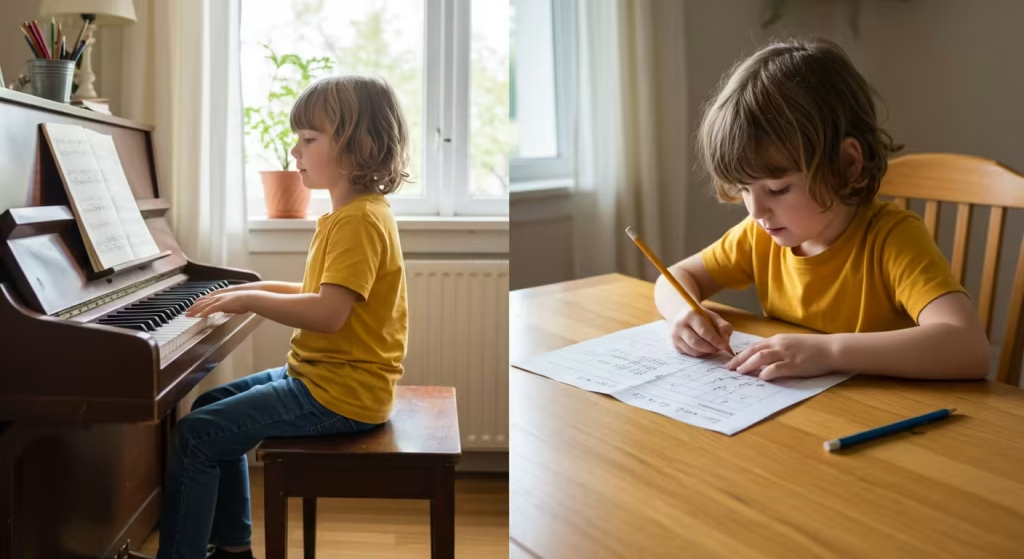
Piano lessons help math skills a lot. Learning music improves pattern recognition and critical thinking skills. It also helps the brain develop cognitively and boosts academic grades significantly. Music and mathematics share deep connections that benefit young learners tremendously.
Many parents ask if piano lessons really help with math homework and tests. The answer is yes. The mathematical benefits can start quickly. Piano instruction helps kids understand numbers, patterns, and complex problems better. This goes beyond just practice; it changes how kids think for a long time, enhancing their cognitive development and mathematical reasoning.

Music Lessons in San Diego with K&M Music School
1 Expert Music Lessons
We offer Piano, Violin, Cello, Guitar, Ukulele, Saxophone, Bassoon, Harp, Voice, and Toddler group lessons for students of all ages and skill levels.
2 Why Choose Us?
- 🎶 Boosts focus and self-discipline
- 🎵 Strengthens cognitive skills
- 🎼 Enhances cultural understanding
- 🎤 Builds confidence through recitals
3 We Welcome Adults Too!
Key Benefits and How It Works:
- Pattern Recognition: Musical scales show mathematical patterns. This takes 3 to 6 months of consistent piano practice.
- Fraction Understanding: Musical notes teach fractions naturally through rhythm and notation. This takes 2 to 4 months of keyboard learning.
- Spatial Reasoning: Reading musical notation helps with visual-spatial skills. This takes 4 to 8 months of musical training.
- Memory Enhancement: Memorizing music compositions improves working memory. This takes 1 to 3 months of regular piano practice.
- Problem-Solving: Playing musical pieces builds critical thinking skills. This takes 6 to 12 months of piano instruction.
Ready to boost your child’s math abilities? Start piano lessons today and witness the transformation in their mathematical thinking!
The Science Behind Piano Lessons and Math Achievement
How Piano Training Rewires the Brain for Mathematics
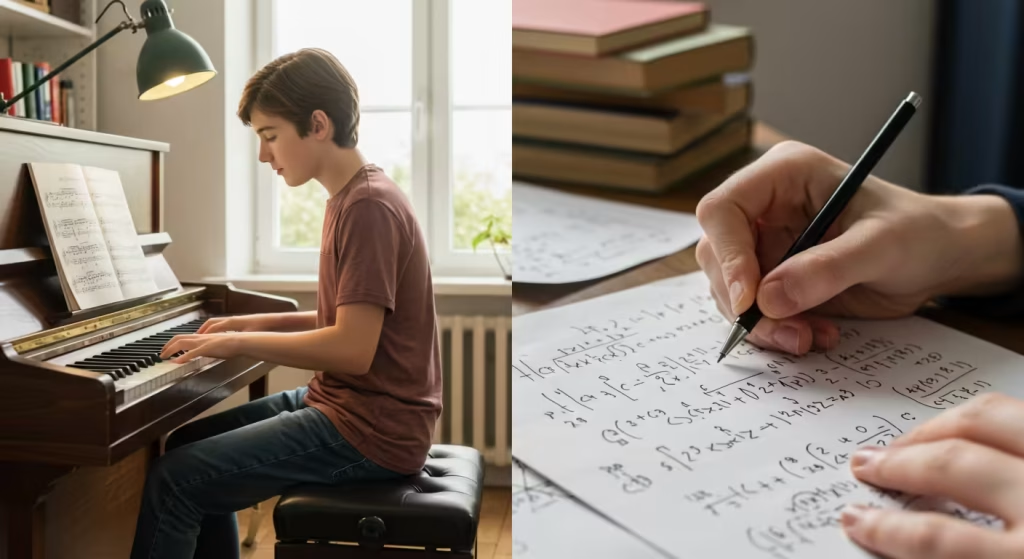
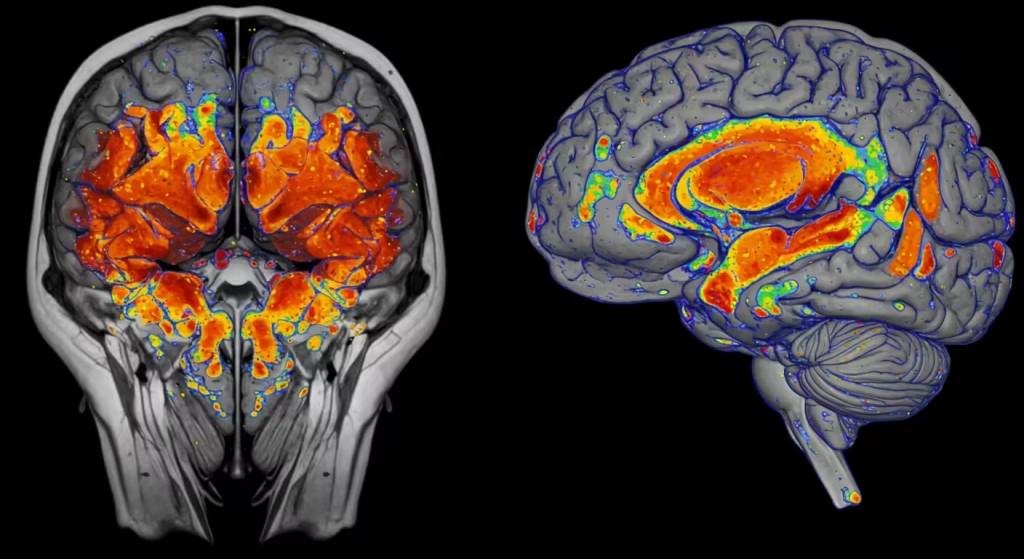
Scientists have discovered something amazing about piano lessons and math skills. When children learn to play piano, their brains actually change structure. These neural changes happen in areas that control mathematical thinking and spatial-temporal reasoning skills.
Learning music builds new brain connections. These neural connections help with mathematical reasoning later. Dr. Frances Rauscher found kids who took piano lessons got better at spatial thinking skills. This cognitive ability is important for geometry, algebra, and more advanced math concepts.
Musical training also strengthens the corpus callosum. This is the bridge between the left and right brain hemispheres. A stronger neural connection means better communication between creative and logical thinking. This enhanced brain connectivity directly supports mathematical problem-solving abilities and cognitive development through music education.
Mathematical Concepts Hidden in Piano Music
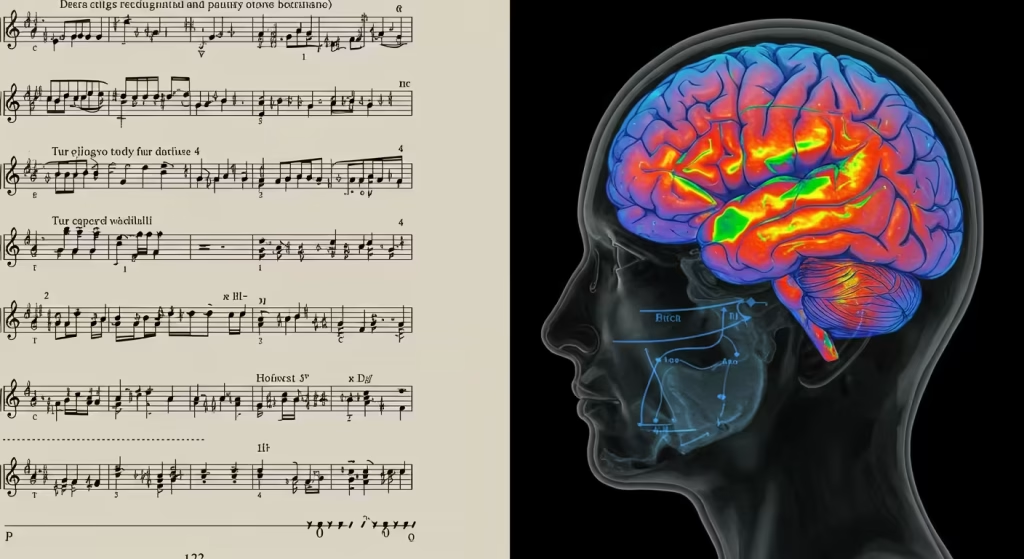
Piano music is full of math concepts that children absorb naturally through musical notation. Every piece of music teaches fractions through note values. A whole note equals four quarter notes. Two half notes equal one whole note. Children learn these mathematical relationships without realizing they’re doing fraction math through musical instruction and keyboard training.
Rhythm patterns in piano music match mathematical sequences perfectly. Scales have clear patterns that help kids learn algebraic thinking. Rhythm patterns in piano music match mathematical sequences. Musical scales have clear patterns that help kids learn algebra concepts. The space between piano keys is equal. This helps kids learn about proportions in mathematics through hands-on keyboard experience.
Time signatures in music are like fractions in mathematics. For example, 4/4 means four beats per measure. Kids who learn time signatures often do better with fractions in math class and develop stronger mathematical reasoning skills. Music theory reinforces mathematical foundations in practical, engaging ways.
Transform your child’s relationship with mathematics! Enroll them in piano lessons now and watch their confidence in math soar!
5 Key Math Skills That Piano Lessons Develop
Pattern Recognition and Mathematical Thinking
Piano scales are excellent for learning mathematical patterns. The C major scale has a set pattern of musical steps. Kids who learn this can use the same pattern recognition in math sequences and problem-solving tasks.
Music has repeating patterns and rhythmic changes. Piano students learn to spot these patterns quickly. This helps them think better in algebra and see mathematical concepts in real life situations through musical training.
The ability to recognize patterns is fundamental to advanced mathematics. Students with strong pattern recognition skills excel in geometry, algebra, and calculus. Piano lessons provide thousands of opportunities to practice this crucial mathematical skill through musical training and keyboard practice.
Fraction Understanding Through Note Values
Note values are fractions in musical form. Quarter notes, eighth notes, and sixteenth notes teach children how fractions work together mathematically. They learn that two eighth notes equal one quarter note, just like 2/8 equals 1/4 in mathematics, building numerical literacy and mathematical competencies.
Kids who struggle with fractions in math often understand them with music notation. Seeing and hearing musical notes makes hard mathematical ideas easier. They can tell if fractions sound right or wrong right away through musical learning and keyboard instruction.
Dotted notes add another layer of fraction complexity. A dotted half note equals three quarter notes, teaching children that 1.5 + 1.5 = 3. These fraction relationships become second nature through regular piano practice and keyboard skills development.
Spatial-Temporal Reasoning Enhancement
Reading piano music develops powerful spatial skills. Students must process multiple lines of music simultaneously, tracking melody and harmony. This multi-dimensional thinking strengthens spatial-temporal reasoning abilities crucial for mathematics and problem-solving.
Hand coordination in piano playing requires precise spatial awareness. Piano students learn to judge distances between keys and coordinate complex finger movements. These skills transfer directly to geometry and engineering concepts in mathematics classes.
Seeing music patterns helps with math graphing and coordinates. Students who “see” musical notation do well with graphs and spatial relationships in math, improving their mathematical abilities and classroom performance.
Memory and Sequential Processing
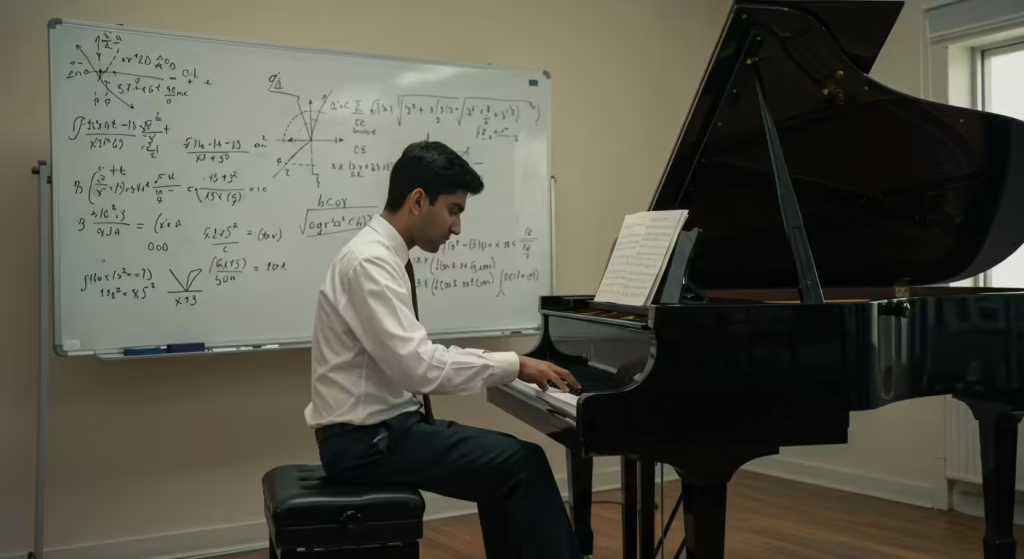
Piano memorization techniques strengthen working memory for mathematical operations. Students learn to hold multiple musical ideas in mind while performing. This enhanced memory capacity directly supports complex math problem-solving and cognitive skills development.
Musical sequences teach children about order and progression. They learn that certain notes must follow others in specific patterns. This sequential thinking is essential for multi-step math problems and logical reasoning skills in mathematics.
The discipline of memorizing piano pieces builds concentration skills. Piano students develop the ability to focus on complex tasks for extended periods. This enhanced focus directly benefits mathematical learning and test performance in academic settings and standardized testing.
Problem-Solving and Critical Thinking
Piano performance requires constant decision-making. Students must interpret musical markings, adjust timing, and solve technical challenges. These problem-solving skills transfer directly to mathematical thinking and reasoning in classroom mathematics.
Music shows kids that problems can have more than one answer. This helps them try different ways to solve math problems creatively, enhancing their problem-solving abilities and mathematical reasoning.
Playing piano builds confidence in solving hard challenges. Kids learn to keep trying and think creatively through musical training. These skills help in advanced math classes and mathematical reasoning throughout education and standardized tests.
Don’t wait to give your child the piano advantage! Contact a piano instructor today and help your child excel in mathematics!
Research Evidence: Piano Lessons Math Skills Connection
Stanford University Study Results
Stanford researchers conducted a landmark study on piano lessons and math skills. They followed 144 preschool children for eight months. Half received piano instruction while the other half received computer training.
The results were remarkable. Children who took piano lessons scored 34% higher on spatial-temporal reasoning tests. These mathematical improvements appeared after just four months of piano instruction. The control group showed no significant improvement in reasoning skills or mathematical abilities.
Dr. Gordon Shaw’s study found piano helps the brain think about space and time. This cognitive skill is important for math, science, and engineering disciplines requiring mathematical reasoning.
Piano lessons help students do better in math all through school. Kids who start piano early score higher on math tests than others consistently throughout their education and mathematical development.
Students with music training score about 100 points higher on SAT math sections. The longer they study music, the better they do in math and academic performance on standardized tests.
The benefits extend beyond test scores. Students with piano background choose math-related college majors more frequently. They also report greater confidence in tackling complex mathematical concepts and problem-solving situations in advanced learning and mathematics education.
Music Lessons in San Diego with K&M Music School
1 Expert Music Lessons
We offer Piano, Violin, Cello, Guitar, Ukulele, Saxophone, Bassoon, Harp, Voice, and Toddler group lessons for students of all ages and skill levels.
2 Why Choose Us?
- 🎶 Boosts focus and self-discipline
- 🎵 Strengthens cognitive skills
- 🎼 Enhances cultural understanding
- 🎤 Builds confidence through recitals
3 We Welcome Adults Too!
Comparison with Other Musical Instruments
All instruments help learning, but piano helps math the most effectively. The keyboard layout shows mathematical relationships clearly, unlike other instruments with different learning approaches to music education.
Piano players read both treble and bass clefs at once. This helps their brain think in flexible ways, more than single-clef instruments, enhancing cognitive abilities and mathematical reasoning.
The piano teaches math through harmony. Students learn how notes combine using ratios and proportions. This builds a foundation for harder mathematical ideas and concepts through keyboard instruction.
Research proves piano lessons boost math performance! Give your child this proven advantage—schedule a piano lesson evaluation today!
Age-Specific Benefits of Piano Lessons for Math Skills
Early Childhood (Ages 3-6): Foundation Building
Young kids who start piano learn number sense naturally. They count beats, measures, and repeats. This helps build a strong foundation for mathematical learning and early math skills.
Finger exercises improve fine motor skills. These physical skills help with writing numbers and math symbols. Kids with good finger control do better at math writing and calculation skills in early mathematics education.
Practicing piano regularly teaches kids to be consistent and keep trying. These learning habits help with learning mathematics, which needs practice and persistence for mastery and mathematical reasoning.
Elementary School (Ages 7-11): Core Math Concepts
Elementary students get the biggest help from piano lessons and math skills. They learn fractions, patterns, and spatial skills faster with musical instruction and keyboard training.
Kids in elementary school often learn multiplication tables quicker through music. Music rhythms help them remember math facts. They make songs to learn multiplication in a fun, engaging way through musical education.
Reading music helps kids recognize symbols. Those who know music symbols well also do better with math symbols. This skill helps them throughout math class and learning mathematical notation.
Middle School (Ages 12-14): Advanced Mathematical Thinking
Middle school piano students develop abstract thinking skills through advanced musical concepts. They learn about musical intervals, chord progressions, and harmonic relationships. These concepts mirror algebraic thinking and proportional reasoning in mathematics education.
Piano students find pre-algebra easier to grasp. They learn about variables by changing keys and transposing music. This shows how the same idea can work with different numbers in mathematics through musical training.
Middle school piano students do well in geometry. Their skills from reading musical notation help them see shapes and write proofs, strengthening mathematical reasoning and spatial-temporal skills.
In high school, piano students solve hard math problems better. Music helps them be creative and keep trying with tough mathematical challenges and problem-solving tasks.
Advanced piano pieces require analysis of form, harmony, and structure. These analytical skills transfer directly to calculus, statistics, and advanced mathematical modeling. Students learn to break complex problems into manageable components through musical training and piano instruction.
College-bound piano students usually get higher scores on standardized tests. Their thinking and problem-solving skills are stronger through music education. These skills help in all school subjects, not just math classes.
Set your child up for middle school math success! Begin piano lessons now to develop the cognitive skills needed for advanced mathematics!
Practical Ways Piano Lessons Boost Math Performance
Daily Practice Routines That Build Math Skills
Using a metronome helps students learn division and fractions without knowing it. Dividing beats into smaller parts is like doing division in mathematics. For example, a quarter note split into two eighth notes shows 1 divided by 2 equals 0.5 through musical training.
Practicing scales helps students recognize mathematical patterns. Playing piano scales every day builds skills to predict what comes next. This helps with mathematical thinking and reasoning through keyboard practice.
Exercises like arpeggios teach about proportions. Finger patterns stay the same in different octaves. This shows mathematical scaling and proportions through musical practice on the piano keyboard.
Games and Activities Combining Piano and Math
Music math games make learning fun for kids. Parents can play fraction wars with musical notes or match patterns with musical intervals. These games teach music and math at the same time, enhancing learning and mathematical skills.
Clapping rhythms while counting helps number skills develop. Kids clap steady beats and count by 2s, 3s, or 4s. This helps their brain work better and improves math fluency through musical activities.
Keyboard geography games teach about coordinates. Kids learn piano keys by letters and numbers. This helps them understand x-y coordinates used in algebra and geometry mathematics through keyboard instruction.
How Piano Teachers Can Emphasize Math Connections
Good piano teachers explain how music and math connect conceptually. They show how note values relate to fractions. They talk about patterns in scales and songs. This helps kids see the link between piano and math skills through music education.
Teachers use mathematical words like “equal parts,” “proportions,” and “sequences.” This helps students spot mathematical ideas in music instruction and piano lessons.
Pictures and charts help kids understand music and math together visually. Teachers use fraction charts and pattern diagrams. These visuals make learning mathematics clearer through musical concepts and keyboard instruction.
Try these piano-math activities with your child today! Their mathematical thinking will improve with each practice session!
Common Myths About Piano Lessons and Math Skills
“Any Musical Instrument Will Do” – Myth Busted
All instruments help the brain, but piano helps math the most effectively. The piano keyboard shows mathematical relationships clearly. Other instruments don’t do this as well for learning mathematics.
Piano students learn harmony and melody simultaneously. This dual-processing requirement strengthens cognitive flexibility in ways that melodic instruments cannot match. The result is enhanced mathematical reasoning ability through piano instruction and keyboard learning.
The piano’s range and versatility allow students to explore complex musical concepts. They learn about mathematical ratios through chord inversions and harmonic progressions. These advanced concepts provide deeper mathematical understanding through keyboard learning and piano training.
“You Need Years of Training to See Benefits” – False
Research shows that piano lessons and math skills benefits appear surprisingly quickly. Stanford studies found spatial-temporal reasoning improvements after just four months of piano instruction. Basic fraction understanding often improves within weeks of starting lessons.
Even short-term piano exposure provides mathematical advantages. Summer piano programs show measurable improvements in mathematical reasoning. The key is consistent practice, not lengthy training periods for cognitive benefits and math skills.
Parents see math homework get easier in the first semester of piano lessons. Kids improve focus, spot patterns better, and solve problems faster. These skills help with math right away through musical training and piano instruction.
“Only Gifted Children Benefit” – Wrong
Piano lessons benefit all children, regardless of initial mathematical ability. Students who struggle with math often show the greatest improvement through musical training. The multi-sensory approach of piano lessons provides alternative pathways to mathematical understanding.
Kids with learning differences often do well in piano but find regular math hard. Piano uses movement and listening, which helps different learners develop skills. These kids often gain confidence in math through music instruction and keyboard learning.
Average students also get better at math with piano lessons. The benefits are for all students. Regular practice and good teaching give clear results for everyone’s mathematical ability and reasoning skills.
Don’t believe the myths! Every child can benefit from piano lessons, regardless of natural ability. Start their mathematical journey through music today!
Choosing the Right Piano Program for Math Skill Development
What to Look for in Piano Teachers
Qualified piano teachers understand the connection between musical and mathematical learning. They emphasize pattern recognition, fraction relationships, and spatial thinking in their instruction. Look for teachers who explicitly discuss mathematical concepts during piano lessons.
Good piano teachers change lessons to fit each student’s learning needs. They see when students need extra help with math ideas. They give special exercises to help. The best teachers link music to math clearly for enhanced understanding and mathematical reasoning.
Piano teachers should encourage regular practice and provide structured learning progressions. Consistent practice schedules support both musical and mathematical development. Teachers who emphasize disciplined practice habits create optimal conditions for academic improvement and math skills.
Online vs. In-Person Piano Lessons for Math Benefits
In-person piano lessons give quick feedback and personal help. Piano teachers watch hand position, posture, and technique closely. This helps kids develop skills that also help with mathematical learning and cognitive development.
Online piano lessons are flexible and use fun technology. Many have games that link music and math concepts. These lessons can add to regular piano learning and skill development for mathematics.
Hybrid approaches combining online and in-person instruction often work best. Students receive personalized attention from human teachers while accessing technology-enhanced learning resources. This combination maximizes both musical and mathematical development effectively through piano instruction.
Budget-Friendly Options for Piano and Math Learning
Community music programs often provide affordable piano instruction. Many communities offer group lessons or subsidized private instruction. These programs maintain quality while reducing costs for families seeking mathematical benefits through music education.
Digital pianos provide an affordable alternative to acoustic instruments. Modern digital pianos offer realistic touch and sound while requiring less maintenance. They also include built-in learning features that support mathematical concept development through music and keyboard practice.
Piano method books with explicit mathematical connections maximize learning value. These books highlight fraction relationships, pattern recognition, and spatial concepts throughout the curriculum. They provide excellent value for self-directed learners interested in mathematical growth through piano instruction.
Ready to choose the right piano program? Contact local music schools today and ask specifically about teachers who understand the math-music connection!
Supporting Your Child’s Piano and Math Journey
Creating a Practice Environment That Reinforces Math
Practice spaces at home should have visuals that show math and music links. Fraction charts help kids see how notes relate to mathematical concepts. Pattern diagrams show scales and sequences for enhanced learning of mathematics through music.
Regular piano practice helps kids learn time management and discipline. They get better at using time and staying consistent. These skills help with math homework and academic success in mathematics classes.
Family support makes the piano and math connection stronger. Parents who care about music and mathematics help kids learn more effectively. Asking simple questions about patterns and fractions during practice helps kids understand better through musical learning and keyboard instruction.
Tracking Progress in Both Piano and Math Skills
Tracking progress helps families see how music and math skills grow together. Keep records of piano pieces learned, math test scores, and homework completion for comparison and mathematical assessment.
Regular checks show where extra help is needed. If fractions are still hard after piano lessons, more practice may help specifically. Finding problems early stops them from getting worse in mathematical learning and reasoning.
Celebrate successes in both areas to maintain motivation. Recognition of improvement in mathematical reasoning builds confidence for continued piano study. Positive reinforcement creates a cycle of success in both musical and academic areas of mathematics.
Dealing with Resistance and Building Motivation
Sometimes kids don’t want to practice piano, even though it helps with math skills. Parents can explain how piano lessons improve math skills measurably. This helps kids want to practice more consistently for mathematical benefits.
Making piano practice fun keeps kids interested in learning. Use games, technology, and creative activities during practice. Fun lessons that connect music and math make learning positive and engaging for mathematical reasoning.
Setting realistic goals prevents frustration and maintains motivation. Small, achievable milestones in both piano and math create momentum for continued learning. Success builds confidence that supports future challenges in both disciplines of music and mathematics.
Start tracking your child’s progress today! Create a simple chart showing piano practice time and math grades to see the correlation develop over time!
Success Stories: Real Students, Real Results
Case Study 1: Elementary Student Math Grade Improvement
Sarah, a third-grade student, struggled with fractions and basic math concepts. Her parents enrolled her in piano lessons hoping to build discipline and creativity. Within six months, her math grades improved from C to A- through musical training and keyboard instruction.
Sarah’s teacher noticed her improved pattern recognition skills first. She began identifying mathematical relationships faster than her classmates. Her fraction understanding improved dramatically through note value practice in piano lessons and musical training.
After one year of piano, Sarah scored in the 90th percentile on standardized math tests. Her parents say piano lessons helped her mathematical abilities significantly. Sarah still studies piano and advanced math and does well in both areas of learning.
Case Study 2: High School Student SAT Score Boost
Marcus started piano in middle school because he had trouble with geometry. His parents hoped music would help his mathematical thinking. It worked better than they thought for his learning and mathematical reasoning.
His grades went from D to B+ in one semester of piano instruction. Music reading and hand exercises made his spatial skills stronger. Hard geometry problems became easier through musical training and keyboard practice.
Marcus scored 150 points higher on the SAT math than expected. His counselor said piano helped his thinking and mathematical reasoning significantly through music education.
Teacher Observations and Academic Performance
Mrs. Johnson, a fourth-grade teacher, notices piano students do better in math consistently. They learn fractions and patterns faster than others through musical instruction and keyboard training.
“Piano students approach math problems differently,” explains Mrs. Johnson. “They’re more patient, systematic, and creative in their problem-solving approaches. They also show better concentration during challenging mathematical tasks.”
High school math teacher Mr. Rodriguez reports similar observations. His piano students demonstrate enhanced spatial reasoning and abstract thinking abilities. They often choose advanced mathematics courses and excel in calculus and statistics through musical training and piano instruction.
These success stories could be your child’s story too! Piano lessons have transformed countless students’ mathematical abilities—yours could be next!
Frequently Asked Questions About Piano Lessons and Math Skills
How Long Before I See Math Improvement?
Most kids get better at math thinking within 3-4 months of piano lessons. Pattern recognition and spatial skills improve first. Then, they understand fractions and solve problems better through musical training and keyboard instruction.
Big math grade improvements usually show by the end of the first year of instruction. Some kids improve faster with regular piano practice. Regular practice and good teaching speed up results in mathematical skills and reasoning.
The benefits keep growing with years of piano lessons. Kids who play piano through high school do better on standardized tests and college entrance exams involving mathematics and problem-solving.
Can Piano Help with Specific Math Struggles?
Piano lessons help kids who find fractions, patterns, and spatial skills hard. Music teaches these mathematical ideas in a different way using sound and movement for better understanding through keyboard instruction.
Kids with attention problems often get better with piano practice. The focus needed for piano helps them concentrate in math classes. Better focus leads to better mathematical skills through music and keyboard training.
Children who feel scared of math gain confidence from piano instruction. Success in music makes them feel good about learning mathematical concepts through pattern recognition and problem-solving that transfer to mathematical contexts and classroom learning.
What Age Should Children Start Piano for Math Benefits?
Kids can start piano lessons as early as 3 or 4 years old. Starting early helps math skills develop the most effectively. But kids can learn piano at any age for mathematical benefits and cognitive development.
A good time to start is between 6 and 8 years old. At this age, kids have the hand skills for piano and are growing in mathematical thinking abilities and reasoning skills.
Middle school students also show significant benefit from beginning piano study. The enhanced cognitive flexibility supports pre-algebra and geometry learning. Even high school beginners can experience mathematical advantages through piano training and keyboard instruction.
How Much Practice Time Is Needed?
Effective piano practice for mathematical benefits requires consistency rather than long sessions. Daily practice of 20-30 minutes provides more benefit than longer, less frequent sessions. Regular engagement strengthens neural pathways most effectively for learning mathematics.
Kids 4 to 7 should practice 15-20 minutes a day. Elementary kids need 20-30 minutes daily. Middle and high school students should practice 30 to 45 minutes. This helps them improve musically and with mathematical skills through keyboard training.
Quality practice matters more than quantity for cognitive development. Focused attention during practice sessions maximizes both musical and mathematical development. Distracted or rushed practice provides minimal benefit for cognitive development and mathematical reasoning skills.
Are Digital Pianos as Effective as Acoustic Pianos?
Modern digital pianos provide comparable benefits to acoustic instruments for mathematical development. The key factors are weighted keys, realistic touch response, and quality sound reproduction. These features support proper technique and spatial awareness development for mathematics.
Digital pianos help with math learning effectively. They have games, metronomes, and recording features. These tools help kids understand mathematical ideas. Digital pianos stay in tune, which helps with recognizing patterns and mathematical relationships.
The key is to practice often on a good piano instrument. Both acoustic and digital pianos work well for learning mathematics. Regular practice and good teaching build the link between piano and math skills development through keyboard training.
Have more questions? Reach out to a local piano teacher today for a free consultation about how piano lessons can address your child’s specific math challenges!
The Future of Music Education and Mathematical Learning
Technology Integration in Piano and Math Teaching
Educational technology increasingly recognizes the piano lessons and math skills connection. New apps and software programs explicitly link musical concepts to mathematical learning. These tools provide interactive experiences that reinforce both musical and mathematical understanding through piano instruction.
AI tutoring adjusts to each student’s learning needs specifically. It finds where students need help in music or mathematics. Personalized lessons help students learn better through technology and keyboard instruction.
Virtual reality lets students see mathematics through music visually. These experiences improve thinking about space and abstract ideas. VR helps more than regular teaching for mathematical concepts and piano instruction.
School Programs Combining Music and Mathematics
Forward-thinking schools integrate piano instruction with mathematics curriculum. These programs explicitly teach mathematical concepts through musical activities. Students learn fractions through note values and patterns through scales and compositions on the keyboard.
STEAM education includes music to help with math skills development. Piano lessons are now part of STEAM programs nationally. These programs prepare students for school and future jobs requiring mathematical thinking and problem-solving.
Teacher training now teaches how music and math connect conceptually. Teachers learn to explain these links clearly. This helps all students, no matter their main subject or learning style, develop strong mathematical abilities through music education.
Advocate for more music-math integration in your school! Share this article with your school principal and music teachers to promote this powerful educational connection!
Conclusion: Making the Connection Work for Your Child
Research shows piano lessons and math skills are strongly connected. Learning music helps kids spot patterns and improve spatial thinking abilities. These skills help in mathematics and school for a long time through cognitive development and musical training.
Parents who choose piano lessons give their kids a big academic advantage. The benefits go beyond music education. Kids get better at problem-solving and feel more confident in mathematics through keyboard instruction.
Starting piano lessons at any age helps with math skills. But starting early gives the most cognitive benefit. Piano lessons help whether kids find math hard or easy through musical training and keyboard practice.
The secret is practicing often and having a good piano teacher. When families support this, kids do great in music and school mathematics through consistent instruction.
Music Lessons in San Diego with K&M Music School
1 Expert Music Lessons
We offer Piano, Violin, Cello, Guitar, Ukulele, Saxophone, Bassoon, Harp, Voice, and Toddler group lessons for students of all ages and skill levels.
2 Why Choose Us?
- 🎶 Boosts focus and self-discipline
- 🎵 Strengthens cognitive skills
- 🎼 Enhances cultural understanding
- 🎤 Builds confidence through recitals
3 We Welcome Adults Too!
TAKE ACTION TODAY!
Don’t wait to give your child the piano advantage for mathematical success. Here’s what to do right now:
- Find a qualified piano teacher who understands the music-math connection
- Schedule a trial lesson to assess your child’s interest and ability
- Invest in a quality instrument – even a digital piano will provide math benefits
- Create a consistent practice schedule to maximize mathematical improvement
- Talk with your child’s math teacher about tracking progress in both areas
Call your local music school today and mention this article for special introductory rates! Your child’s mathematical future is waiting to be unlocked through the power of piano lessons.