

Online guitar lessons are easy to use. First, this guide helps beginners learn guitar. Then, it covers advanced techniques. Also, it is made for your skill level.
Learning to play guitar is easier now than ever before, thanks to the many online lessons available. Whether you’re a beginner with your first acoustic or an advanced player, online instruction can help you simplify and speed up your learning.
| Skill Level | Essential Skills | Recommended Tools |
|---|---|---|
| Beginner | Tuning, basic chords (G, C, D, A, Em), strumming patterns, reading tabs | Yamaha FG800, Fender FA-115, Guitar Tricks, Fender Play |
| Intermediate | Chord progressions, pentatonic scales, home recording, effects pedals | Metronome, audio interface (e.g., Focusrite Scarlett Solo), DAWs (Garageband, Cakewalk) |
| Advanced | Composing solos, jazz improvisation, guitar customization, teaching | Custom guitar parts (tuners, bridges), video platforms for remote teaching |
Skill Level
Beginner
- Start by choosing a beginner acoustic guitar
- Learn how to tune it
- Practice basic chords like G, C, D, A, and Em
- Work on strumming patterns
- Learn to read guitar tabs
- Use Guitar Tricks or Fender Play for guided video lessons
- Learn open chords before barre chords
Intermediate
- Chord progressions (I-V-vi-IV)
- Pentatonic scales for solos
- Home recording gear
- Effects pedals
- Play along with backing tracks
- Record yourself to analyze the technique
- Metronome practice for timing
Advanced
- Writing intricate solos
- Improvising jazz changes
- Customizing guitars
- Teaching students
- Compose solos strategically
- Target chord tones when improvising
- Personalize guitars to needs
Getting Started: Beginner Guitar Lessons Online
Are you just starting with the guitar? There are many beginner lessons online. These lessons help you learn quickly. First, you can practice strumming chords. Then, you can start playing songs.
Choosing the Best Beginner Acoustic Guitar
Before diving into lessons, you’ll need a beginner-friendly acoustic guitar. The key is finding a budget model that plays easily yet sounds decent. Useful features to look for include:
- Steel strings rather than nylon. Steel-string acoustics better emulate the tones of popular music.
- Full dreadnought or auditorium-size bodies. Larger bodies deliver richer sounds compared to smaller travel sizes.
- Smooth fretboard edges. Sharp fret ends quickly lead to painful fingers for new players.
- The budget price tag is ideally under $150. You don’t need an expensive guitar as a beginner. Upgrade later once you improve.
Here are some of the best acoustic guitars for beginners. They are chosen for their ease of play, sound quality, and price. These guitars are affordable and perfect for new players.
- Yamaha FG800 – A long-standing budget favorite with a solid spruce top and nato back/sides. Easy playability with a very balanced tone.
- Fender FA-115—This guitar features a loud basswood body and comfortable neck, ideal for new players. It offers Fender quality on a starter budget.
- Epiphone DR-100 – All-laminate construction but still delivers classic dreadnought sound. Fun to strum with its vibrant tone.
- The Jasmine S35 is a small acoustic guitar that’s easy to travel with. However, it still makes a big, full sound. It is built strong and has Sapele wood on the back and sides.
While these models are great starter choices, always try before you buy if possible. Make sure your beginner acoustic feels comfortable to hold and play. The guitar should excite you whenever you pick it up.
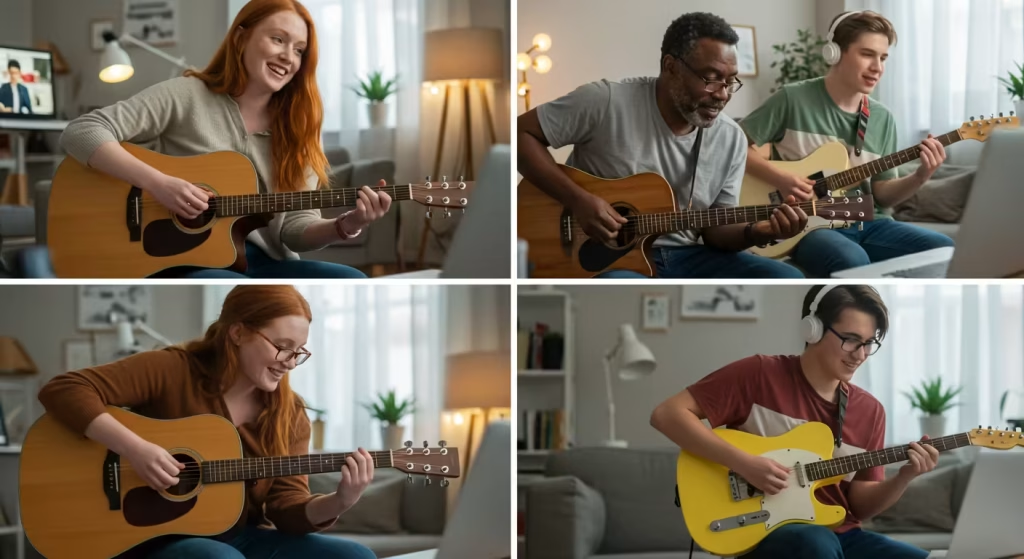
Tuning Your Guitar Properly
Before playing the guitar, make sure it is tuned. Tuning makes the open strings match the right notes, helping your chords sound correct when you strum.
The standard tuning for acoustic and electric guitars is EADGBE. It goes from the lowest string to the highest string.
- Low E – 329.63 Hz
- A – 440 Hz
- D – 587.33 Hz
- G – 196.00 Hz
- B – 246.94 Hz
- High E – 329.63 Hz
When tuning, the goal is to match the frequency (Hz) of each string to these values using a guitar tuner. There are several tuner options:
Clip-on tuners: These attach directly to the guitar’s headstock and sense string vibrations. They are easy to use for beginners.
For mobile apps, use guitar tuner apps like GuitarTuna. These apps use your phone’s microphone to hear the pitches. Then, they help you tune your guitar easily.
Online tuners help you tune your guitar for free. This makes tuning easy.
For pedals, use standalone stompbox guitar tuners. For example, the TC Electronic Polytune clips onto your pedalboard, making tuning your guitar easy.
All-in-one floor units: Devices like the Boss TU-3 combine a tuner and metronome in a sturdy floor unit.
Take your time when tuning your guitar. Check each string more than once until the frequency is correct. Tune slowly and listen carefully. When you tune often, your chords will sound clear.

Music Lessons in San Diego with K&M Music School
Expert Music Lessons
We offer Piano, Violin, Cello, Saxophone, Bassoon, Harp, Voice, and Toddler group lessons for students of all ages and skill levels.
Why Choose Us?
- 🎶 Boosts focus and self-discipline
- 🎵 Strengthens cognitive skills
- 🎼 Enhances cultural understanding
- 🎤 Builds confidence through recitals and performances
We Welcome Adults Too!
Book Your Free Lesson NowBeginner Guitar Chords to Master
After your guitar is tuned, you can start learning basic chords. Chords are made by strumming several notes at the same time. In contrast, melodies play one note at a time.
Chord Notation
Numbers on horizontal lines show the guitar strings. Numbers on vertical lines show which frets to press.
Tips for Learning Chords
- Practice patience and practice lead to progress.
- Focus on clean transitions between chords.
- Keep your fretting fingers close to the strings to reduce hand movement.
- Change chords smoothly without rushing.
Mastering the Basics
Practice these five chords well before trying more difficult barre chords.
Useful Beginner Barre Chords
- F
- B minor
- C minor
- A minor
These chords have versatile sounds that open up new progressions. Use chord charts and take it slowly getting used to awkward finger positions.
Daily Practice
With daily practice, you’ll quickly memorize basic chord shapes. This vocabulary lets you play countless popular songs.
Strumming Patterns for Acoustic Guitar
Strumming is essential for rhythm guitar playing. After learning some chords, practice strumming patterns to get comfortable. Focus on evenly timed strums before incorporating advanced muted strokes.
Work on these basic strumming patterns:
- Downstrokes only: Simply strum down with your dominant hand. Keep wrist loose.
- Up down down: Alternate between up and downstrokes. Control pick angles.
- Down down up up down up: Add syncopation by repeating downs before ups.
Once you feel comfortable, start strumming while changing chords. Then, use the chord changes to switch patterns. This helps your muscles remember the rhythm. As a result, your rhythm guitar playing feels natural.
Best Online Guitar Lessons for Beginners
YouTube has lots of free guitar videos. However, structured lessons on special learning platforms are better for guided learning. These top platforms offer feedback tools and track your progress. Also, they provide personalized lessons.
Guitar Tricks
Guitar Tricks is a top online guitar lesson site. It has over 11,000 videos for electric and acoustic guitars, bass, and ukulele. For beginners, they offer the Core Learning System. This system helps you build skills through songs, exercises, and theory.
Standout features:
- Detailed tracking of your progress and goals
- Massive on-demand lesson library with top teachers
- Daily song and lesson recommendations based on the ability
Fender Play
Numbers on horizontal lines show the guitar strings. Numbers on vertical lines show which frets to press. Also, remember that patience and practice lead to progress.
Standout features:
- Structured learning paths to avoid feeling overwhelmed
- Options for genre-specific lessons
- Quizzes and practice tools to reinforce techniques
Numbers on horizontal lines show the guitar strings. Numbers on vertical lines show which frets to press. Also, remember that patience and practice lead to progress.
How to Read Guitar Tablature
Classical and jazz guitarists use standard notation. However, most modern guitar music uses tablature. This is also called the “guitar tab.” The guitar tab shows the notes and chords you play on the guitar.
Numbers on horizontal lines show the guitar strings. Numbers on vertical lines show which frets to press. Also, remember that patience and practice lead to progress.
E|—0—0—0—0—0—0—0—|
B|—1—1—1—1—1—1—1—|
G|—0—0—0—0—0—0—0—|
D|—2—2—2—2—2—2—2—|
A|—2—2—2—2—2—2—2—|
E|—0—0—0—0—0—0—0—|
In this example, play the open low E string, 1st fret on the B string, 2nd fret on the D and A strings, and then the open high E string. Numbers move up the fretboard as you progress from left to right.
The guitar tab conveys melodies and chords without formal music reading ability. Learn to read basic tabs early in your development. Many websites provide free tab charts for popular songs.
Once you learn these core ideas, you will have a strong base for beginner guitar skills. Next, be patient and practice regularly. This will help you make progress.
After you learn open chords, barre chords, strumming, and tabs, you can start intermediate lessons. These lessons help you get better step by step. They also teach you more about the fretboard. Plus, they build your music theory and playing skills.
A chord progression refers to a sequence of chords played one after the other. Many popular songs follow common chord progressions depending on genre:
- Pop/rock songs often utilize I-V-Vi-IV progressions. For example, in the key of G major: G-D-Em-C chords.
- Blues and jazz standards frequently use ii-V-I progressions. In A major: Bm7-E7-Amaj7 chords.
First, learn these progressions in every key. This helps you play songs by ear quickly. Also, ask a musical friend to play melodies. Then, play your chord progressions along with their melodies.
Use a metronome and focus on smooth transitions between chords in a progression. Strum through chord changes fluidly without stopping. Pay attention to how slight alterations in strumming patterns impact the feel.
Soon you’ll internalize chord progressions and changes.
Understanding Guitar Scales for Melodies and Solos
Guitar scales are sequences of notes played in an ascending or descending order. They provide the foundation for lead guitar melodies and solos.
The minor pentatonic scale is very important for beginners. First, it sounds good with blues and rock songs. Second, the pattern repeats at different frets, letting guitarists solo all along the neck.
Learn the A minor pentatonic box pattern below. Next, try adding bends and slides. Also, use hammer-ons and pull-offs when you feel ready. This makes your lead lines more expressive.
Mixing scale patterns with chord strumming expands your musical versatility.
Gear Every Improving Guitarist Needs
As your ability progresses, upgrade your equipment with these guitar accessories:
- A metronome/tuner combo has two tools in one stompbox. First, it helps you keep the tempo with a metronome. Also, it tunes your guitar. This makes practicing easier and more convenient.
- A capo clamps onto the guitar’s neck. This makes the strings shorter. Then, you can play the same chords in different keys.
- Extra Picks and Strings: Keep backups handy for when inevitable breakages occur.
- Guitar Stand: Make your instrument readily accessible to encourage more playing time. Prop it safely when not in use.
- Basic Effects Pedals: Units like overdrives, delays, reverbs, and loopers open creative doors.
While gadgets are fun, using a metronome helps you play better. Focused practice with a metronome makes you improve faster.
While gadgets are fun, using a metronome helps you play better. Focused practice with a metronome makes you improve faster.
Recording yourself is hugely beneficial for analyzing technique, songwriting, and preserving musical ideas. Luckily home recording is more accessible than ever for guitarists.
For beginners, the easiest way is to get an audio interface like the Focusrite Scarlett Solo. This device turns your instrument into digital signals for your computer. Next, connect some studio monitor speakers. Then, you are ready to record your music.
You can use free digital audio workstations, or DAWs, for software. These programs have everything you need for basic recording.
- Garageband – Mac built-in DAW great for guitars. Amp/pedal simulators and editable grooves.
- Cakewalk – Fully-featured Windows DAW popular for its flexibility.
- Audacity – Open-source, cross-platform editing software. Limited compared to other DAWs but easy to use.
Explore recording riffs, chord progressions, scales, and full songs. Hearing back your playing objectively will highlight areas needing refinement. Be sure to archive your best musical ideas.
Setting up a basic home recording studio helps you develop your skills quickly. First, you can review your work. Then, you can practice songwriting. This way, you improve faster.

Reaching the Advanced Guitar Stages
If you are an experienced player, you can take advanced lessons. These lessons offer bigger challenges and better rewards. For example, you can write complex solos. Also, you can master difficult theory. Moreover, learning never stops no matter how much you know.
Composing Convincing Guitar Solos
Writing cool guitar solos over your songs helps you stand out. When you make a solo:
- Target chord tones: Emphasize notes from current underlying chords. Outline changes.
- Incorporate scales: Add runs and patterns from related scales. Link positions.
- Develop memorable licks: Create a sequence of notes that become your signature phrases.
- Build off transcriptions: Analyze and borrow elements from your favorite guitarists.
- Map an arc: Sketch a solo skeleton before playing. Introduce themes that reappear over time.
Recording yourself often reveals bad habits. Be hypercritical, keeping only your best ideas. Construct solos like a story.
Improvising Over Chord Changes
If you play jazz or blues guitar, improvising solos is very important. To master songs in your style, you should:
- Knowing chord tones cold. Target chord notes on strong beats.
- Visualizing chord shapes everywhere on the neck. See how scales interlock with chords.
- Developing phrase vocabulary: Stock licks to splice into lines spontaneously.
- Listening to guitar masters: Absorb the language of fluid improvisers.
Regularly backing tracks to practice improvising full choruses. Stay relaxed, and phrase coherently. Transcribe yourself to analyze choices.
Jazz guitar great Joe Pass said it best: “Improvisation is the ability to play anything you hear.” Strive to open that door.
Customizing Your Electric Guitar
Making your electric guitar your own makes it feel like part of you and matches your sound style. So, think about swapping parts like:
Tuning Machines: Upgrade to locking, ratio-based tuners for better intonation at alternate tunings.
No matter how you teach, explain things clearly. Also, encourage passion in your students. Then, make learning fun. Additionally, students will inspire you to keep improving your skills.
Bridges: Tailor string stability, sustain, and tone with custom bridges. Tremolos enable pitch dips/dives.
Neck shapes: Thinner or thicker profiles impact comfort and playability. Custom carve to your hand.
Don’t be afraid to make an axe your own. Even small tweaks make a difference.
Music Lessons in San Diego with K&M Music School
Expert Music Lessons
We offer Piano, Violin, Cello, Saxophone, Bassoon, Harp, Voice, and Toddler group lessons for students of all ages and skill levels.
Why Choose Us?
- 🎶 Boosts focus and self-discipline
- 🎵 Strengthens cognitive skills
- 🎼 Enhances cultural understanding
- 🎤 Builds confidence through recitals and performances
We Welcome Adults Too!
Book Your Free Lesson NowConclusion: Your Guitar Goals Are Within Reach
There are more online guitar lessons now than ever. With the right lessons and regular practice, you can get better at guitar. Stay open to learning new things and keep your passion for playing. This makes learning easier and more fun, one step at a time.
Ready to start your guitar journey? Sign up for our online lessons today and begin playing the songs you love. Whether you’re a beginner or looking to advance your skills, our comprehensive guides and supportive community will help you every step of the way. Pick up your guitar and let’s make music together!
Frequently Asked Questions
What is the best beginner acoustic guitar?
Thought for a couple of seconds
The Yamaha FG800 is a great guitar for beginners. It is comfortable to play, has a balanced sound, and costs less than $150.
Should I take online or in-person guitar lessons?
Online lessons are more flexible and cheaper. However, in-person classes let teachers correct you directly. So, try remote lessons first. Then, have occasional in-person check-ins.
How long does it take to learn guitar?
Beginners should start with some basic gear. First, get a tuner and a capo. Next, buy slides, extra picks, and strings. Also, get a stand and basic effects like overdrive, reverb, and delay pedals. Then, upgrade your accessories as you improve.
What free software is best for recording guitars at home?
For beginners, try free digital audio workstations. For example, use Audacity on Windows or Mac. You can also try GarageBand on Mac or Cakewalk on Windows. These programs are easy to use. They have enough features to record guitar tracks.
Should I learn music theory?
Start by focusing on playing. Next, learn basic music theory, such as scales, chords, and time signatures. This will help you understand the fretboard and improve your technique.
How often should I change my guitar strings?
Change steel-string acoustic guitar strings every 3-4 months with regular playing. Rotate electric strings every 1-2 months. Check for grime, debris, and worn fretboard notches as signs to replace strings.
What guitar accessories are essential?
Beginners should start with some basic gear. First, get a tuner and a capo. Next, buy slides, extra picks, and strings. Also, get a stand and basic effects like overdrive, reverb, and delay pedals. Then, upgrade your accessories as you improve.