

Acoustic, digital, or keyboard — decoded with real 2026 prices. One spec matters more than all the others.
The Short Answer
An 88-key digital piano with weighted hammer action is the best first instrument for most beginners. It protects technique, never needs tuning, and works with headphones at bedtime. Expect to spend $450–$550.
- Best for most88-key digital piano, weighted action — $450–$550
- Short trial only61-key keyboard — around $200
- Best soundUsed upright acoustic, if you have the room and the budget
- The spec that mattersWeighted or graded keys, not the number of voices
- Ongoing costAcoustic tuning runs $100–$300 a year; digital, nothing
You and your child are standing in a music store. Three instruments sit within twenty feet of each other: a used upright in the corner, a slim digital piano on a stand, and a light keyboard leaning against a box. All three are labeled “learn to play piano,” and all three cost wildly different amounts.
They are not the same instrument. The difference that matters isn’t the price tag or the brand on the fallboard — it’s what happens when a finger presses a key. This guide explains that difference, gives you real October 2026 prices, and ends with a five-minute test you can run in any shop.
Acoustic vs Digital vs Keyboard: What Each One Really Is
The three categories share a shape and almost nothing else.
Acoustic pianos
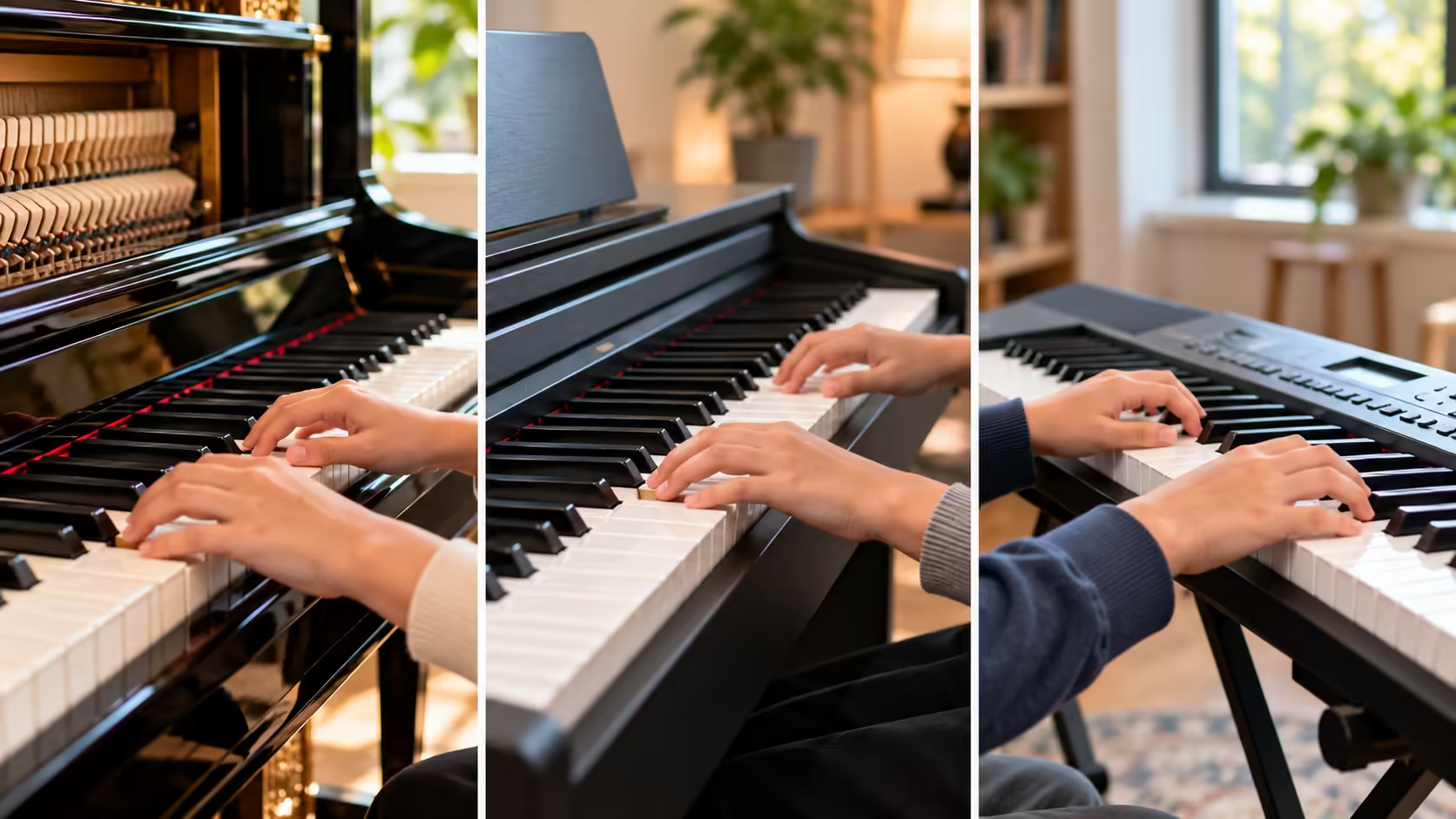
Real strings, real hammers, real wood. The sound comes from the instrument, not a speaker. Two shapes suit beginners best — the upright and the console — and both stand against a wall and claim real floor space.
There’s no power cord and no volume knob. Every note is honest, which is exactly the point: you can’t hide a weak touch behind a built-in recording. The trade-off is upkeep, and it arrives every single year.
Digital pianos
A full-size keyboard with sampled piano sound, built-in speakers, and a realistic action. Serious beginner models carry 88 keys with weighted, graded hammer action, so the bass keys feel heavier than the treble keys, much like an acoustic.
You get a headphone jack, a volume control, and often USB or Bluetooth. You also get something no acoustic can offer: silent practice at 9 p.m.
Keyboards, portable and arranger
Lighter, cheaper, and usually shorter — 61 keys is the common size. The keys are unweighted or semi-weighted, so they spring back rather than falling like a hammer. Keyboards carry hundreds of extra sounds, rhythms, and backing tracks. They’re built for portability and fun, not for building piano technique.
One sentence that settles the confusion: a keyboard is an electronic instrument that plays piano sounds. A digital piano is built to feel and behave like an acoustic piano. That difference lives almost entirely in the keys.
The One Spec That Decides Everything: Key Action
If you read only one section of this guide, read this one. Key action is what separates a real instrument from an expensive toy, and it’s the spec most shoppers skip past on the way to the voice list.
Weighted keys
Each key carries a mechanism that mimics a real piano hammer. You control volume by how hard and how fast you press, which is the entire foundation of expressive playing. Piano teachers treat this as non-negotiable for anyone learning technique, and with good reason: a student who can’t shape a quiet note has no way to shape a phrase.
Graded hammer action
Bass keys feel heavier, treble keys feel lighter. This mirrors a real piano, where longer bass strings need more energy to move. Most beginner digital pianos in the $450–$550 range now include it.
Semi-weighted keys
The middle ground. There’s some resistance but no hammer mechanism. Semi-weighted is genuinely fine for pop, chords, and casual playing, and weaker for classical study. It’s the honest budget compromise.
Unweighted keys
Light plastic keys on springs. Cheapest to build, weakest for technique. Fine for a four-week interest test. Not fine for a year of lessons.
| Key type | How it feels | Best for | Drawback |
|---|---|---|---|
| Weighted / graded | Close to a real piano | Lessons and classical study | Costs more |
| Semi-weighted | Slight resistance, no hammer | Pop and casual playing | Less control over volume |
| Unweighted | Very light and springy | Testing interest only | Builds habits you’ll unlearn |
What you get at each price in 2026
| Budget | What to expect |
|---|---|
| Under $300 | Keyboards with light or semi-weighted keys |
| $300–$450 | Entry-level weighted 88-key digitals |
| $450–$550 | Good graded hammer action — the value sweet spot |
| $550–$1,000 | Better key feel, noticeably better speakers |
| $1,000+ | Console models with furniture cabinets and three pedals |
88 Keys vs 61 Keys: How Many Does a Beginner Need?
Key count is the second big fork in the road, and it’s simpler than the marketing suggests.
Why 88 keys matters
Standard piano music spans all 88 keys. Beginner books stay near the middle for the first few months, then start reaching outward in both directions. A 61-key board runs out of room right when the music starts getting interesting — and there’s a reason that number is the standard. We covered the history in why pianos have 88 keys.
When 61 keys is genuinely enough
- Testing whether a child actually enjoys sitting at a keyboard
- Pop songs and chord accompaniment, where the hands stay central
- A small apartment or a shared bedroom with no floor space
- Travel, or a second instrument for a school practice room
The simple rule: if the student plans to take lessons for more than six months, buy 88 keys. If not, 61 or 76 keys is an honest, cheap choice — just go in knowing it’s temporary.
Best Beginner Digital Pianos in 2026
Prices below were checked in October 2026 and move week to week, so treat them as a guide rather than a quote.
Roland FP-10 — best key feel under $600
Eighty-eight keys with Roland’s PHA-4 hammer action, which is the best touch available anywhere near this price. Controls are minimal and the speakers are modest, but the thing a student’s hands actually learn from is excellent. If key feel is your priority, this is the pick.
Watch for: bundles with a stand and pedal push the total past $640, so price the pieces separately before you commit.
Yamaha P-145 — the popular all-rounder
Eighty-eight weighted keys in a compact, genuinely portable body, with Bluetooth on the BT version. It’s the safest default recommendation for a family that wants one instrument to carry a student for years, and it’s light enough for a parent to move alone.
Yamaha P-45 — the budget workhorse
Eighty-eight weighted keys, simple controls, no extras — real action at the lowest price that still counts as a piano. It’s the outgoing generation of the P-145, so stock is thinning and discounts show up often. Worth grabbing if you find one.
Alesis Recital and Recital Pro — entry-level 88 keys
Eighty-eight semi-weighted keys with built-in speakers, at roughly $200 for the Recital and $280 for the Pro. Not hammer action, so not ideal for classical study — but a reasonable middle step for a family that wants full key count without committing $500 yet.
Bundles and console models
A bundle with a stand and bench typically runs around $680 for a popular 88-key model. That’s often worth it, since you need all three pieces anyway and buying separately rarely saves much.
Console digital pianos look like furniture, include a built-in stand and three pedals, and start near $1,000. They suit families who want the instrument to live permanently in a living room rather than get packed away. If you’re weighing specific brands at this level, our digital piano buyer’s guide compares them in detail.
| Model | Approx. price | Key type | Main draw |
|---|---|---|---|
| Alesis Recital | $200 | Semi-weighted | Cheapest real 88-key option |
| Alesis Recital Pro | $280 | Semi-weighted | Better speakers |
| Yamaha P-45 | $450 | Weighted | Lowest-cost true weighted action |
| Roland FP-10 | $500 | Weighted hammer | Best touch at the price |
| Yamaha P-145BT | $530 | Weighted | Compact, Bluetooth |
| 88-key bundle | $680 | Weighted | Includes stand and bench |
| Console digital | $1,000+ | Graded hammer | Furniture cabinet, three pedals |
Best Beginner Keyboards in 2026
A keyboard has one real job in a beginner’s life: find out whether the interest is real, without spending much.
What a keyboard buys you
- A low price — solid 61-key beginner models start around $200, and most good ones stay under $350
- Light weight, so it moves between rooms or houses easily
- A fast answer to the only question that matters in month one: does this child want to sit down and play?
- A useful second instrument later, for travel or a school practice room
The honest limit
A keyboard will not build piano technique. If lessons continue, expect to replace it within 12 to 18 months. And here’s the arithmetic most families miss: buying a $200 keyboard and then a $500 digital piano costs more than buying the digital piano first.
So if you already know your child is starting lessons, skip the keyboard entirely and go straight to weighted 88 keys. The keyboard is for genuine uncertainty, not for easing in.
A cheaper way to skip this decision: renting a proper instrument for the first few months costs a fraction of buying one and removes the risk completely. That’s exactly what our rental program is for — ask us what’s available.
Best Beginner Acoustic Pianos in 2026
Acoustic still wins for some families, and for real reasons.
Why acoustic still wins
Real sound, real response, and no dependence on electricity. Children learn to control volume with their bodies, and that skill transfers to every instrument they touch afterward. A well-kept upright lasts decades and holds its value far better than any digital.
The real yearly cost
Purchase price varies enormously by brand, age, and condition, so a used upright can land anywhere between $500 and $2,500 — and a careful inspection matters more than the asking price. Then budget for upkeep:
- Tuning: typically $100–$200 per visit, reaching $300 in some markets. Once a year is the minimum; twice is better for a new instrument settling in.
- Moving: a local move runs a few hundred dollars, and a long-distance move can pass $1,000. Get two written quotes first.
- Repairs: sticking keys, worn hammers, and regulation work are all normal on an older piano, and none of them are cheap.
About free pianos: a free upright from a relative or a neighborhood listing is only free until a technician looks inside. Pay for an inspection before you pay for the move. A piano that needs a new set of strings and a pinblock costs more to repair than a good digital costs to buy.
The room and noise problem
An acoustic piano cannot be turned down. In an apartment or a house with shared walls, that single fact decides the question. A digital piano with headphones solves late-evening practice completely, and late-evening practice is often the only practice a busy family gets.
When to choose acoustic
Choose acoustic when you have a house with space for it, a student who’s past the first year and clearly committed, and a genuine willingness to pay for yearly tuning. If any of those three is missing, a digital serves you better. For a deeper look at the trade-off, see acoustic vs digital piano for beginners.

Cost of Ownership: The Five-Year Comparison
This is the table most buying guides skip, and it’s the one that tells the truth. The purchase price is only the first line of the bill.
| Cost | Keyboard | Digital piano | Used acoustic |
|---|---|---|---|
| Purchase | $200+ | $280–$680 | $500–$2,500 |
| Stand and pedal | Often included | $50–$150 extra | Included |
| Yearly tuning | None | None | $100–$300 |
| Moving | Free | Free | A few hundred dollars |
| Headphones | $30–$100 | $30–$100 | Not possible |
| Repairs | Low | Low | Can be substantial |
| Five-year total | $200–$400 | $400–$1,000 | $1,000–$4,000 |
What the numbers say: the keyboard looks cheapest and often becomes the most expensive, because it gets replaced. The digital piano lands in the middle and earns its keep in daily use. The acoustic carries the highest total cost and the best sound — a fair trade if you’ll actually maintain it.
Piano Features That Matter — and Ones You Can Ignore
Polyphony
Polyphony is how many notes the instrument can sound at once, including notes still ringing under the sustain pedal. 128 notes is plenty for a beginner. Don’t pay extra for 256 unless the player plans to record layered tracks.
Speakers and headphones
Small speakers sound thin, so check the wattage and listen in person. For apartment practice, though, the headphone jack matters far more than speaker power — and a decent pair of over-ear headphones does more for the experience than a speaker upgrade.
Pedals
A sustain pedal is not optional. Buy one with the instrument. A simple on-off pedal is fine to start; a half-damper pedal is a later upgrade once the student reaches music that needs it.
Specs you can safely ignore at first
- Hundreds of extra instrument voices — a beginner uses two or three
- Built-in rhythms and backing tracks
- App connectivity, unless the teacher actually uses it in lessons
- Recording features, until there’s something worth recording
Matching the Piano to the Player
The right instrument depends on who’s sitting at it.
Ages 5 to 7
Short lessons, short practice sessions. Buy weighted keys if the budget allows. A 61-key keyboard is acceptable for the first six months and no longer. A proper adjustable bench matters more at this age than at any other, because feet and wrists need to sit at the right height.
Ages 8 to 12
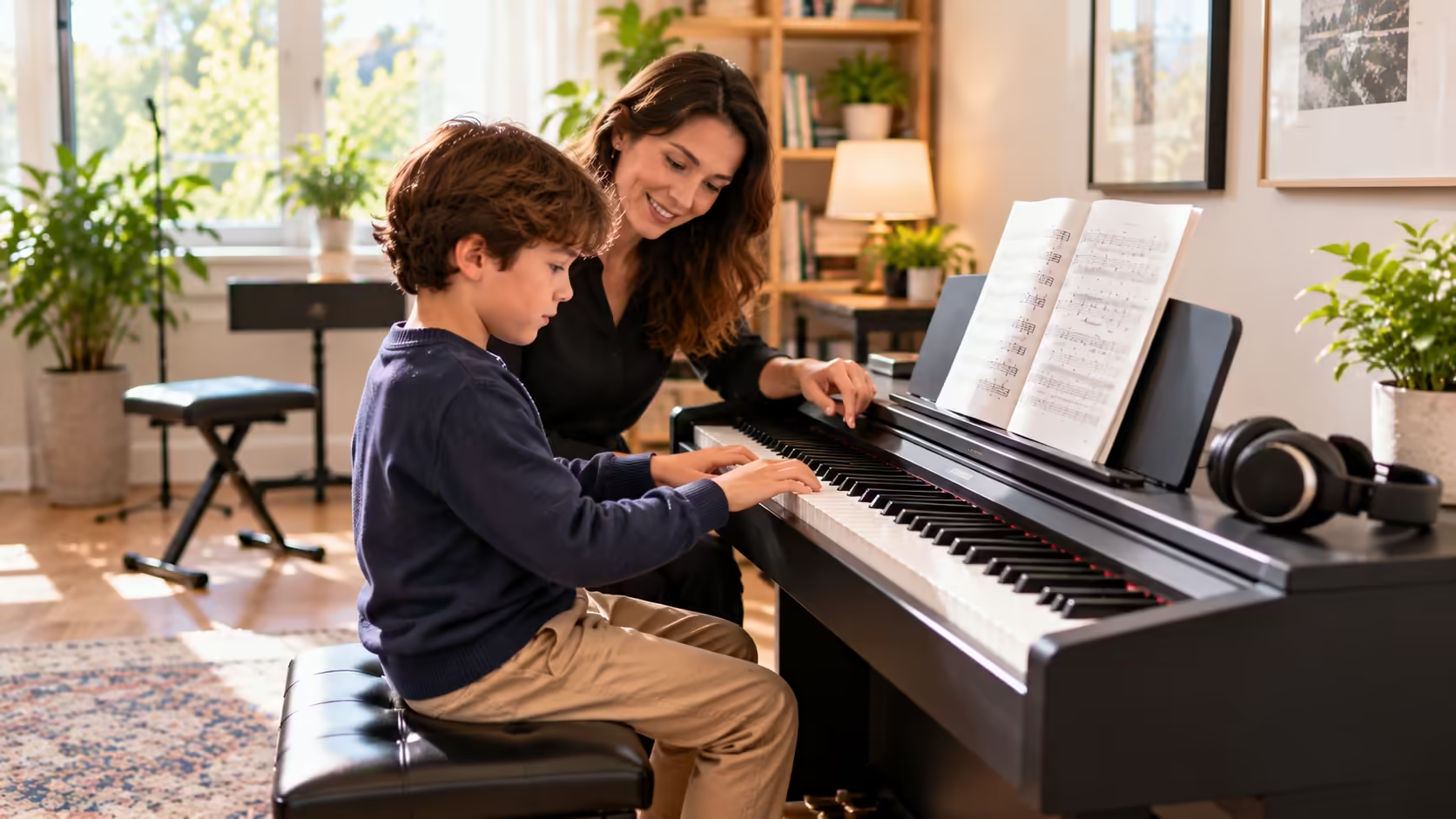
This is the prime window for an 88-key digital with weighted action. Add a bench and a stand at the correct height, and the setup will carry the student through years of piano lessons without another purchase.
Teens
Buy once, buy well. A $450–$530 digital piano will carry a student through high school comfortably, including whatever exam or audition repertoire comes up.
Adults returning to piano
Weighted action matters just as much here — adult hands notice a cheap key immediately, and the frustration is a real reason people stop. A console digital suits a living room and a serious habit. If you’re wondering whether it’s too late, it isn’t: am I too old to learn piano answers that properly.
| Student | Best choice | Budget |
|---|---|---|
| 5-year-old trying piano | 61-key keyboard | $200+ |
| 8-year-old starting lessons | 88-key weighted digital | $450–$530 |
| Teenager taking lessons | 88-key weighted digital | $450–$700 |
| Adult beginner | Weighted digital or used upright | $500–$2,000 |
| Family with a music room | Used upright acoustic | Varies widely |
The Five-Minute Store Test
Most buyers spend twenty minutes reading reviews and ninety seconds pressing keys. Flip that ratio and you’ll avoid the most common regret.
- Press a low key, then a high one. The bass should feel noticeably heavier. If every key feels identical, there’s no graded action.
- Play as softly as you possibly can. A good action lets you produce a quiet note on purpose. A bad one gives you silence, then a sudden sound.
- Play one note fast, five times in a row. Listen for a consistent response and watch for a key that doesn’t return in time.
- Put the headphones on. This is how the student will hear it most of the time. Thin or harsh here means thin or harsh forever.
- Press every key, bottom to top. Dead notes and sticking keys are easy to find and impossible to ignore later.
- Check the bench height. Feet flat on the floor, wrists level with the keys. A wrong bench undoes a right piano.
- Ask exactly what’s in the box. Stand, pedal, and power supply are often sold separately, and that’s where a $500 piano becomes a $650 purchase.
Bring the student. Their hands will tell you more in five minutes than any spec sheet, and they’ll be far more invested in an instrument they helped choose.
8 Common Beginner Piano Buying Mistakes
- Buying 61 light keys and calling it a piano. It’s a keyboard, and a student on lessons will outgrow it inside a year.
- Skipping the sustain pedal to save $40. It appears in beginner books sooner than most parents expect.
- Choosing a model with no headphone jack. In a shared home, that one omission decides when practice can happen.
- Paying for 500 voices instead of a good action. The voices get used twice. The action gets used daily.
- Accepting a free acoustic piano without an inspection. Pay a technician before you pay a mover.
- Forgetting to budget for tuning and moving. An acoustic’s real price includes both, every year.
- Buying online without pressing the keys. Specs can’t tell you how an action feels under your own hand.
- Chasing a brand name over a comfortable action. The logo doesn’t practice. The keys do.
A modest piano played daily beats a great piano that sits closed. That’s the whole buying philosophy in one sentence — and it’s worth remembering, because the instrument is rarely the reason students stop. Why most people quit piano covers the real reasons.
Quick Recap
The whole guide in one breath. An 88-key digital piano with weighted hammer action suits most beginners, and entry models run roughly $450–$530 right now. A $200 keyboard is fine for testing interest but not for a year of lessons. Semi-weighted 88-key models sit in between at $200–$280. An acoustic upright gives the best sound and asks for $100–$300 of tuning every year, plus moving costs.
Weighted keys first, key count second, extra features last. Buying among the best beginner pianos in 2026 comes down to keys, not logos.
Conclusion: Let Your Hands Decide
For most families, an 88-key digital piano with weighted hammer action is the safest and smartest first purchase. It protects technique, needs no tuning, and works with headphones at bedtime — which means it gets played.
Here’s your next step. Spend twenty minutes at a local shop this week. Play two weighted 88-key digitals back to back, then sit at a used upright for two minutes and feel the difference. Your hands will give you a better answer than any review, including this one.
Start Piano With K&M Music Company
Our teachers start at the very first note, for children and adults alike, and they’ll tell you honestly whether the instrument you’re eyeing will serve your student. Not ready to buy? Rent first and decide later.
FAQs About Choosing a Beginner Piano
What are the best beginner pianos in 2026?
An 88-key digital piano with weighted keys suits most beginners. The Roland FP-10 at around $500 has the best key feel at the price, and the Yamaha P-145 at around $530 is the most versatile all-rounder. Both carry a student for years.
Is acoustic or digital better for a beginner?
Digital suits most beginners: it costs less, never needs tuning, and works with headphones. Acoustic wins on sound and long-term value, and makes sense once you have the space, the budget for yearly tuning, and a committed student.
Should a beginner buy 61 or 88 keys?
Buy 88 keys if lessons will continue past six months. Standard piano music uses the full range, and beginner books start reaching outward within months. Choose 61 keys only for a short trial period.
Are weighted keys really necessary?
Yes, for anyone learning technique. Weighted keys let you control volume with your touch, which is the foundation of expressive playing. Light springy keys build habits that take real work to undo later.
What is graded hammer action?
A key mechanism where the bass keys feel heavier and the treble keys feel lighter, mirroring a real piano. Most digital pianos in the $450–$550 range include it, and it’s the closest a digital gets to an acoustic touch.
How much does a decent beginner piano cost?
Weighted 88-key digital pianos run roughly $450–$530, and console models start near $1,000. Budget another $100–$250 for a stand, bench, sustain pedal, and headphones.
How much does piano tuning cost?
Most tunings run $100–$200 per visit, rising toward $300 in some markets. Plan on once a year at minimum, and twice a year for a piano that’s new to your home or has just been moved.
Can I learn piano on a cheap keyboard?
You can learn notes, chords, and basic reading. You can’t build real touch, because unweighted keys don’t respond to how hard you press. Plan to upgrade within a year if lessons continue.
Should I buy a used acoustic piano?
Only after a technician inspects it. Free and cheap pianos often need hundreds of dollars in repairs, and the inspection costs far less than discovering the problem after you’ve paid to move it.
What else do I need to buy besides the piano?
A stand, an adjustable bench, a sustain pedal, and headphones. Budget $100–$250 on top of the instrument, and check what’s already in the box before you add anything.
Katherine Dvoskin
Katherine is a professionally trained pianist who studied at the Gnessin School of Music in Moscow. She has spent decades teaching students of every age, and has sat beside more families than she can count while they decided which piano to bring home.
She writes beginner guides for K&M Music Company with one goal: make the first step small enough that anyone will take it. See all lessons at K&M Music Company →