Lessons are only the first line on the bill. Here’s what a year of music really costs — and the five places families actually save.
The Short Answer
Private music lessons run $35–$50 per 30 minutes, or $70–$100 an hour. A playable beginner instrument costs $150–$800, or $25–$45 a month to rent. Then add $150–$600 a year for books, strings, reeds, repairs, and fees. A realistic first year lands near $3,150 — and a careful one can come in under $500.
- Private lessons$35–$50 per 30 min · $70–$100 per hour
- Monthly lesson billAbout $170 for weekly 30-minute lessons
- First instrument$150–$800 to buy · $25–$45 a month to rent
- The costs nobody quotes$150–$600 a year in supplies, repairs, and fees
- Realistic first year$415 bare-bones · about $3,150 typical
- Cheapest honest startVoice, recorder, or ukulele
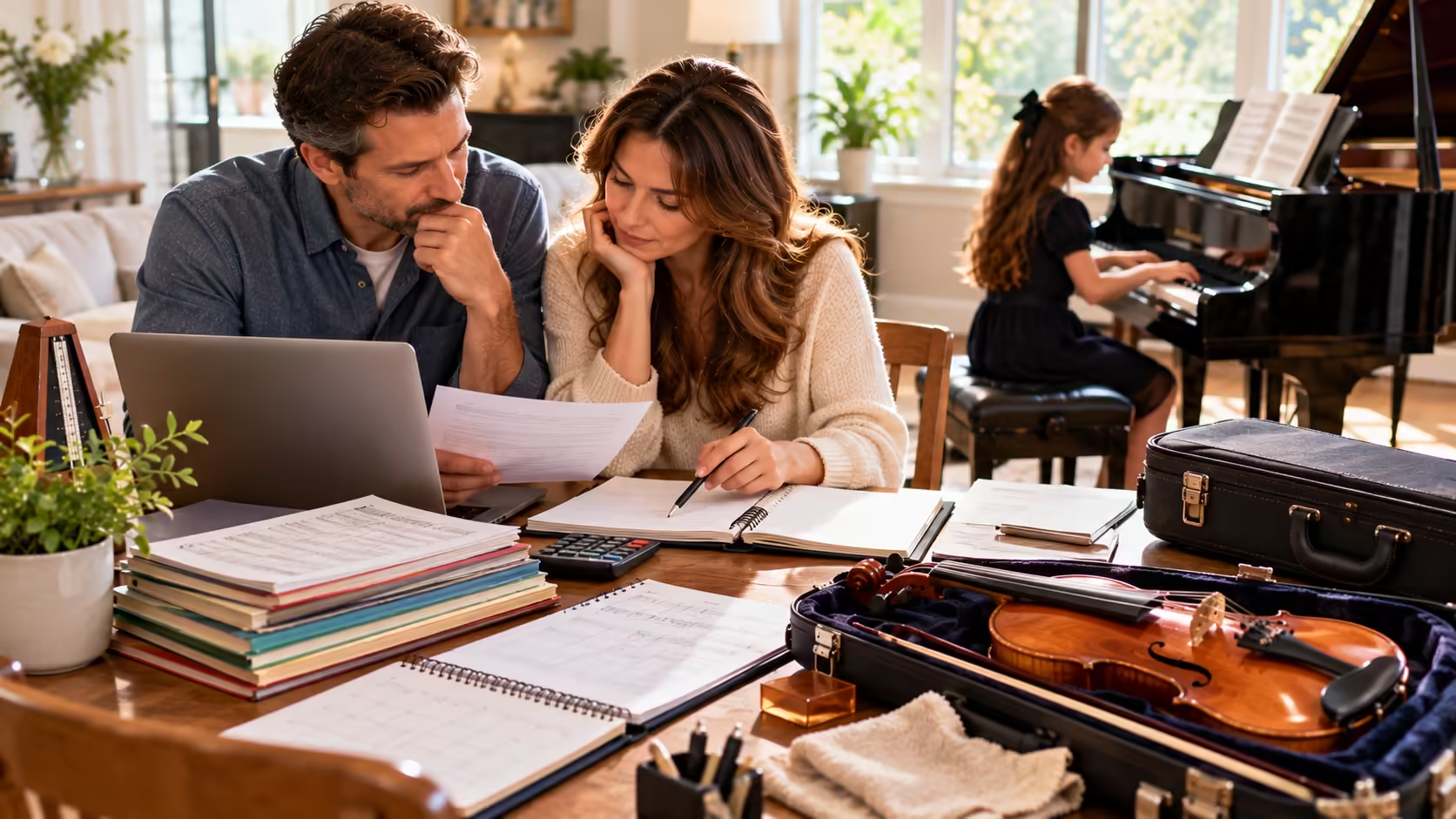
Most price lists stop at the lesson fee. That single number hides almost everything. By the end of a first year, the real cost of learning music usually lands two to four times higher than the hourly rate a teacher quotes — because setup, strings, reeds, tuning, books, and exam entries all arrive separately, and none of them appear on the studio’s price page.
That’s why a year of music can cost one family $470 and another $5,800. The gap isn’t luck. It comes from a handful of choices you can plan for before you spend a dollar. This guide breaks down lesson prices by format, instrument costs by type, and the quiet bills nobody warns you about — so you know your number before your first lesson, and where you can trim it without slowing a student down.
The Real Cost of Learning Music in 2026: At a Glance
| Expense | Typical cost | What families should know |
|---|---|---|
| Private lessons | $35–$50 per 30 min $70–$100 per hour | Beginners usually need only 30 minutes |
| First instrument | Violin $300–$800 Digital piano $400–$730 | A very cheap instrument often needs paid repairs |
| Instrument rental | $25–$45 per month | Cheap for a year, expensive for five |
| Books and supplies | Books $4–$23 Tuners $16–$63 | Ask the teacher what to buy first |
| Graded exams | $55–$90 at beginner grades | Entirely optional — enter only when ready |
| Piano tuning | $100–$200 a visit, twice a year | Regular tuning prevents far bigger repairs |
Bottom line: music lessons cost more than tuition. Budget for the instrument, the consumables, the fees, and the maintenance, and the total stops surprising you.
How Much Does Learning Music Cost? Your First Year, Line by Line
Here’s a full first year for one beginner, with a bare-bones column, a realistic column, and a generous one.
| Expense | Low | Typical | High |
|---|---|---|---|
| First instrument | $150 | $550 | $1,200 |
| Lessons for the year | $170 | $2,040 | $4,800 |
| Accessories (stand, tuner, case) | $40 | $120 | $280 |
| Reeds, strings, consumables | $30 | $110 | $400 |
| Method books and sheet music | $25 | $80 | $200 |
| Exams and recitals | $0 | $100 | $275 |
| Maintenance and repairs | $0 | $150 | $370 |
| First-year total | $415 | About $3,150 | About $7,500 |
The low column isn’t a trick. It’s an app or an occasional lesson instead of a weekly one, a used instrument, and no exams. It’s a real path, and plenty of adults start there.
Monthly lesson prices. Weekly 30-minute lessons run about $170 a month, usually between $140 and $200. Weekly 60-minute lessons average about $320 a month, and $400 isn’t unusual in a big city. Lessons are nearly always the largest real expense, which means lesson length and lesson format are where most families genuinely save.
What the table doesn’t count. It counts money, not time. Thirty minutes of practice five days a week is 130 hours a year. A 20-minute drive each way to lessons adds roughly 56 hours more. And it skips the upgrade cliff: most students need a better instrument by year two or three. Save a little from month one and that jump feels normal instead of sudden.
The Three Cost Layers Behind Every Music Bill
Every music budget has three parts. Miss one and the plan breaks.
Layer 1 — start-up costs
The instrument, a case, a stand, a tuner, and a first method book. You pay it once, all at the front, which is exactly why it causes the most sticker shock. A parent sees a $700 violin and stops reading. That’s a mistake, because for most students start-up is the smallest lifetime cost on the list.
Layer 2 — ongoing costs
Lessons, strings, reeds, rosin, valve oil, tuning, app subscriptions. These decide whether a student lasts five years or five months. Weekly lessons at $45 across 48 weeks come to $2,160 in a year — more than almost any beginner instrument.
Layer 3 — surprise costs
A dropped flute needs a repad. A bow needs a rehair. A bridge cracks. A string snaps the night before a recital. Most budgets fail right here, and the failure is emotional rather than financial: a $120 repair in a tight month can end a habit that was going perfectly well. Hold a few hundred dollars as a repair buffer and you’ll barely feel those hits.

The Real Cost of Music Lessons, Format by Format
Lesson prices swing widely, and the format explains most of the swing.
Private lessons: the benchmark
Across the US in 2026, expect $35–$50 for a 30-minute lesson and $70–$100 for a full hour. Studios in expensive metros push past that, small towns sit below it, and independent teachers often quote close to $1 per minute — a rough shortcut that turns out to be surprisingly accurate.
What you’re buying is correction speed. One-on-one, a teacher fixes a collapsing wrist, a flat tone, or a misread rhythm in the moment, before it becomes a habit. That’s why private lessons usually beat group lessons for beginners despite costing more per hour.
Group classes: the biggest discount
Group music classes are dramatically cheaper. Where weekly hour-long private lessons might run $320–$355 a month, the same hour in a group often costs $100–$140. For families testing whether a child will stick with music, that’s the most efficient dollar on this page.
You trade feedback speed for the saving. In a room of eight, a teacher simply cannot fix every shoulder and every bow hold. Many families run a group class for a term, then switch to private lessons once the interest is proven.
Online lessons: near-parity pricing
Online lessons rarely cost much less than in-person ones. Most sit at $40–$90 for 30 minutes and $60–$150 for an hour. What you save is travel, not tuition — which is a real saving, just not one that shows up on the invoice. For instruments where the teacher mostly watches hands, it works well; for anything where tone and room sound matter, in person still wins.
Apps, courses, and self-teaching books: the budget route
A structured learning app is the cheapest organized path there is — roughly $150–$200 a year, or $15–$20 a month. Self-teaching books and video courses cost less still. Set that against $2,040 for a year of weekly 30-minute lessons and apps win on price by a mile.
They lose on tone, posture, and accountability. An app can tell you that you played a wrong note. It can’t tell you that your thumb is squeezing the neck, or that you’re breathing in the wrong place.
School and community programs
School band and orchestra are usually the cheapest real entry point — often free, sometimes a small participation fee. A good school program gives a child basic technique, basic theory, and the thing that keeps most students going: other kids to play with. Community programs and places of worship often subsidize places too, and some run free group classes.
Always ask about loaner instruments. A surprising number of programs keep a closet of them, and some have donated pianos available to any family who asks.
What changes the price most
- Teacher experience. A university student charges less than a performer with a master’s degree and twenty years of studio teaching. Both can be right for a beginner — see how teaching backgrounds differ.
- Location. A downtown studio in a major metro charges more than a suburb or a small town.
- Lesson length. Thirty minutes suits young beginners; 45–60 minutes suits adults and exam prep.
- Setting. In-home lessons carry a travel premium. Studio slots cost less.
- Payment terms. Semester or annual plans usually carry a modest discount.
What an Instrument Really Costs, by Type
Sticker price is half the story. Setup and upkeep finish it.
| Instrument | Beginner price | Extra supplies | Ongoing upkeep |
|---|---|---|---|
| Voice | $0 | Water, a recording app | None |
| Recorder | $10–$40 | Cleaning rod | None |
| Ukulele | $50–$100 | Strings, clip-on tuner | Very little |
| Acoustic guitar | $150–$300 | Strings, picks, strap | $40–$80 a year |
| Digital piano (88 weighted keys) | $400–$730 | Stand, bench, pedal | Almost none |
| Violin | $300–$800 | Bow, rosin, shoulder rest | Strings and bow care |
| Flute | $200–$600 | Cleaning tools | Occasional pad work |
| Clarinet | $100–$400 | Cork grease, swab | Reeds, pad work |
| Trumpet | $200–$600 | Valve oil, brush | Very little |
| Alto saxophone | $400–$1,200 | Neck strap, swab | Reeds and repairs |
| Cello | $500–$1,200 | Bow, rosin, endpin stop | Strings and bow care |
A good beginner violin usually costs $300–$800, and our full breakdown of renting versus buying a violin walks through the math in detail. An 88-key digital piano with weighted keys lands around $400–$730 — see acoustic vs digital piano for beginners for which features actually matter. A playable beginner acoustic guitar runs $150–$300. And plenty of children start on a classroom recorder, still the least expensive honest instrument on the list.
The voice exception. Singers spend almost nothing on gear, so every dollar goes to teaching — which matters more here than anywhere else, because bad vocal technique causes real injury. That isn’t a loophole. It’s a reallocation: put the instrument money into better voice lessons.

Buy, Rent, or Borrow?
- Rent if…Your child is young, still growing, or not yet sure. Rentals start around $25 a month for violins, flutes, clarinets, trumpets, and violas; saxophones and cellos sit nearer $45. Most plans fold in damage protection, and ours lets you switch sizes as a child grows — ask what’s available.
- Buy used if…A teacher or a shop can inspect it before you pay. A cheap violin with a warped bridge costs more to fix than a fair one with a proper setup. Our guide to choosing a used instrument covers what to check.
- Buy new if…You’re buying a digital piano or a guitar. Entry models are reliable, warranties are real, and resale holds up reasonably well.
- Borrow if…A school, program, or relative has one sitting idle. One caution: a free acoustic piano still needs a technician’s look first, because moving and tuning a “free” piano routinely costs $300 or more.
14 Hidden Costs of Learning Music Nobody Warns You About
None of these appear in a teacher’s quote.
- Reeds and strings. Alto sax reeds run about $30 for a box of 10, and a committed player goes through several boxes a year. Bowed instruments need fresh strings regularly: a student violin set is $25–$60, while a professional set runs $80–$120 — worth it eventually, not in year one. Our violin string upgrade guide explains when to make the jump.
- Piano tuning. An acoustic piano needs tuning at least twice a year, at $100–$200 a visit — commonly $150–$185. That’s roughly $300–$370 annually before a single repair. Digital pianos need none of it, which is their quiet financial advantage.
- Repairs you can’t predict. A dropped woodwind needs repadding. A cracked guitar top needs gluing. A bow needs a rehair every year or two. Budget a few hundred dollars so one small accident never ends the habit.
- Accessories that aren’t optional. A clip-on tuner is $16–$30, a tuner-metronome combo $40–$63. Add a stand, a bag, and a stand light: another $50–$80.
- Method books and sheet music. Beginner books run $4–$23 each, and students need two or three a year plus exam pieces and songs they actually want to play. Ask upfront whether your studio bills materials separately.
- Exam and grading fees. Graded exams cost roughly $55–$90 at beginner levels and $120–$200 at the highest grades, depending on the board. Recorded and digital performance grades usually cost less than in-person exams. If you’re preparing for one, here’s what an exam term actually involves.
- Recital and accompanist fees. A hall fee, a program fee, and a pianist for one performance add up, as do festival entries. All optional — and all among the events students actually remember. Here’s how a first recital usually goes.
- The upgrade moment. Around year two or three, most players outgrow a starter instrument, and a step-up often costs several times the original. Put aside $15–$25 a month from the beginning and the upgrade becomes a decision rather than a crisis.
- Instrument insurance. Anything worth more than a few hundred dollars deserves coverage, usually as a rider on a home policy. Check your rental agreement first, though — damage protection is often already included.
- Travel and waiting time. A weekly 30-minute lesson with a 20-minute drive each way costs 70 minutes of your week: about 56 hours a year, before any practice. It’s the cost nobody invoices and parents feel most.
- Technology. Recording, performing, or taking online exams eventually means a microphone, headphones, or an interface. Buy it when a specific need appears, not in anticipation.
- Practice space. Digital pianos need headphones, acoustic drums need a tolerant household, and anything living in a closed case gets played far less. Space is a cost even when it isn’t a bill.
- Camps and masterclasses. The most expensive optional item here and the fastest accelerator of progress — a week can move a student further than a term. Treat it as an upgrade, not a requirement, and look at what a camp under $500 covers before assuming it’s out of reach.
- The cost of quitting. If a student stops at month 14, the instrument resells for well under what you paid and the accessories are worth almost nothing. It’s the single strongest argument for renting first — and for understanding why students actually quit, which is almost never the money.
A Full Year for Three Real Households
Three honest budgets, start to finish.
The low-cost self-starter
Used acoustic guitar $200, learning app $170, tuner and stand $60, one string change $40. An adult teaching themselves with structure, usually adding an occasional paid lesson to check technique before bad habits set in.
Ten years, including one instrument upgrade: about $2,700.
The typical school-band student
Rented clarinet at $25 a month ($300 a year), weekly 30-minute lessons at $45 across 48 weeks ($2,160), books $80, accessories $70, reeds $90, one exam entry $80.
Ten years, including one upgrade: about $27,000 — roughly $52 a week.
The serious piano student
| Expense | Cost |
|---|---|
| Digital piano | $600 |
| Weekly 60-minute lessons ($85 × 48) | $4,080 |
| Books and sheet music | $150 |
| Exam fees | $140 |
| Bench, stand, headphones | $170 |
| One week of music camp | $400 |
| First-year total | $5,540 |
Ten years, including one upgrade: about $50,000. Worth noting: a digital piano never needs tuning, which is one of the few places a keyboard genuinely beats an acoustic on cost.
Scenario B is where most families land, and it works out near $52 a week over a decade — less than many households spend on takeout in a month. Ten years of music costs roughly what a used car costs. A skill you keep for life is harder to price.
Adults vs Kids: Who Pays More?
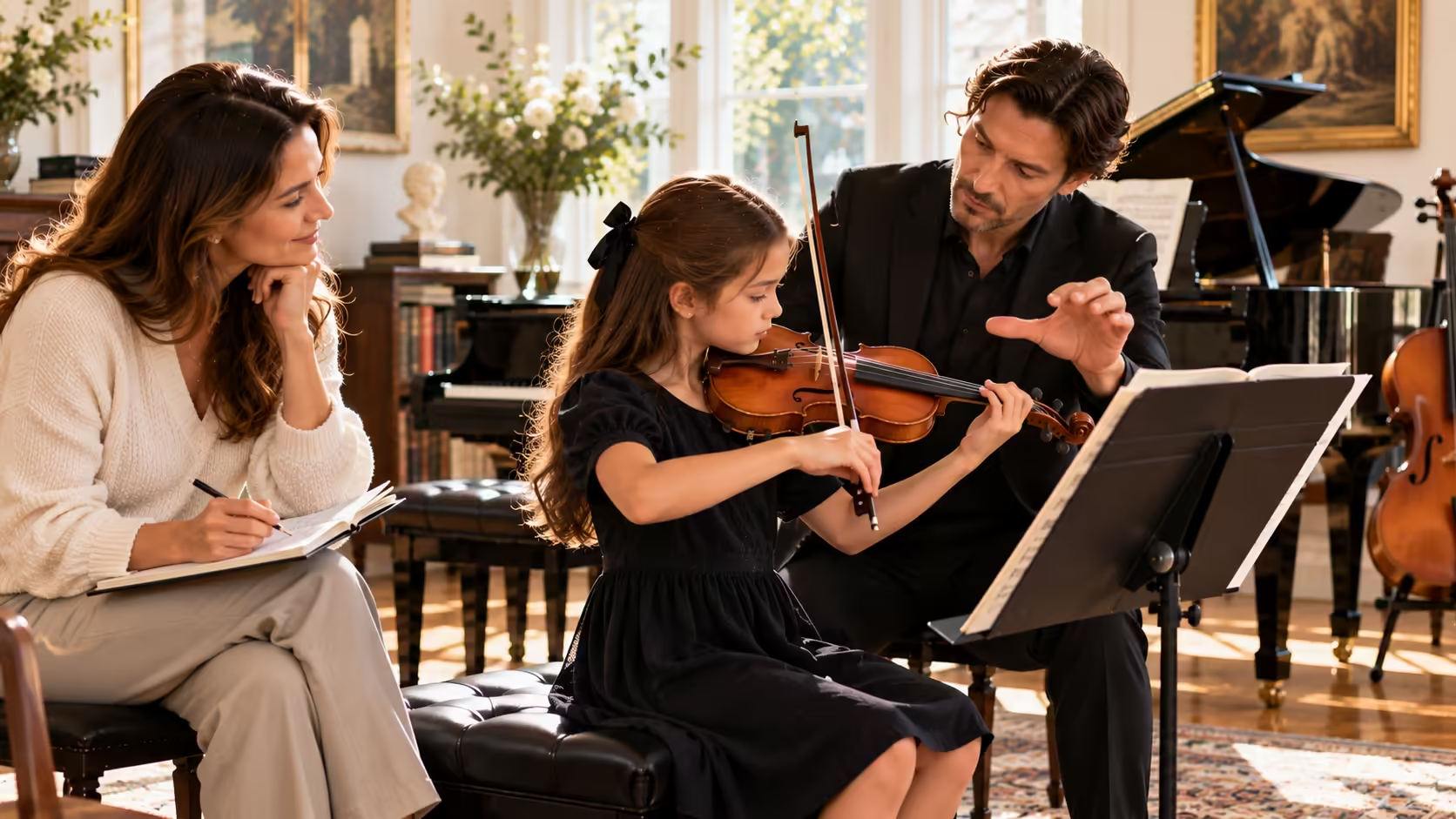
Adults usually pay more per hour. Adult beginners book 45- or 60-minute lessons where children start at 30, and most adults buy a good instrument on the first attempt — which removes the upgrade cost entirely.
Children usually cost more overall. Kids grow. A violin or cello needs a larger size every 18–24 months, and that’s three or four size changes before adult dimensions. School programs and youth ensembles offset part of the bill, but only children can use them.
The adult advantage is flexibility: no size changes, no exam fees unless you want them, and practice time is entirely your call. An adult can start for about $170 a month with weekly 30-minute lessons — or for $170 a year with an app plus the occasional lesson. If you’re wondering whether it’s too late, it almost certainly isn’t, and adult lessons are built around real schedules.
Are online music lessons actually cheaper?
| Path | Yearly cost | Best for | Drawback |
|---|---|---|---|
| Learning app only | About $170 | Notes, rhythm, basics | No one correcting you |
| Group classes | $1,200–$1,700 | Beginners on a budget | Little individual attention |
| Online private lessons | $2,000–$4,500 | Tight or shifting schedules | Needs solid internet |
| In-person private lessons | $2,040–$4,800 | Children, beginners, exams | Travel time |
| School music program | Often free or minimal | School-age children | Large groups |
The hybrid most teachers now recommend: weekly private lessons plus a $170-a-year app for daily practice. The app costs about 8% of the lesson bill and can double the quality of home practice. You pay a teacher for correction, then drill on your own time. It’s the best value on this page.
Which Instruments Cost Least Over Five Years
Ranked by total five-year cost, not sticker price:
- Voice — teaching only, no gear
- Recorder — minimal entry, common in schools
- Ukulele — tiny entry cost, cheap strings, endless free material. Ukulele lessons are the most forgiving first step there is
- Acoustic guitar — low entry, modest upkeep, huge learning ecosystem
- Digital piano — higher entry, near-zero upkeep, strong resale
- Flute and clarinet — modest entry, steady reed and pad costs
- Trumpet and trombone — durable, occasional valve work
- Violin — low entry, higher ongoing cost from strings and bow work
- Saxophone — reeds and repad work add up. Start with the right beginner sax and you’ll spend less on repairs
- Cello — size changes, strings, bow rehairs
- Acoustic drums — space, sound control, heads, cymbals
- Acoustic piano — moving, twice-yearly tuning, action regulation
One thing matters more than the ranking: the cheapest instrument is the one that gets played daily. A $300 violin that lives in its case costs more per hour than a $700 guitar someone picks up every evening.
18 Ways to Cut the Cost of Learning Music Without Slowing Progress
Before You Spend
Five decisions made in the first week that change the whole first year.
- Rent for the first six months. Cheaper than one wrong purchase, and you can switch sizes.
- Buy used from a shop that offers trade-in credit. The credit is often worth more than the discount.
- Ask your school about loaner instruments. Many have them and never advertise it.
- Check community programs and places of worship. Subsidized places exist in most towns.
- Apply for scholarship places at youth programs. Far less competitive than families assume.
On lessons:
- Start with weekly 30-minute lessons, not 60.
- Take a group class for the first term, then go private.
- Pay by semester for the discount, if cash flow allows.
- Book every two weeks and practice twice as hard between.
- Pair lessons with a $170-a-year app for daily drilling.
- Ask about sibling rates, family rates, and whether the first lesson is a free trial — ours is.
On gear:
- Buy a tuner-metronome combo instead of two devices.
- Skip the branded case; a plain gig bag protects just as well.
- Replace strings on a schedule, not on impulse.
- Buy reeds by the box, never singly.
On fees:
- Choose recorded or digital exams over in-person hall exams.
- Skip competitions in year one.
- Hold a repair buffer so one accident never ends the lessons.
Cheap Instrument Traps That Cost More Later
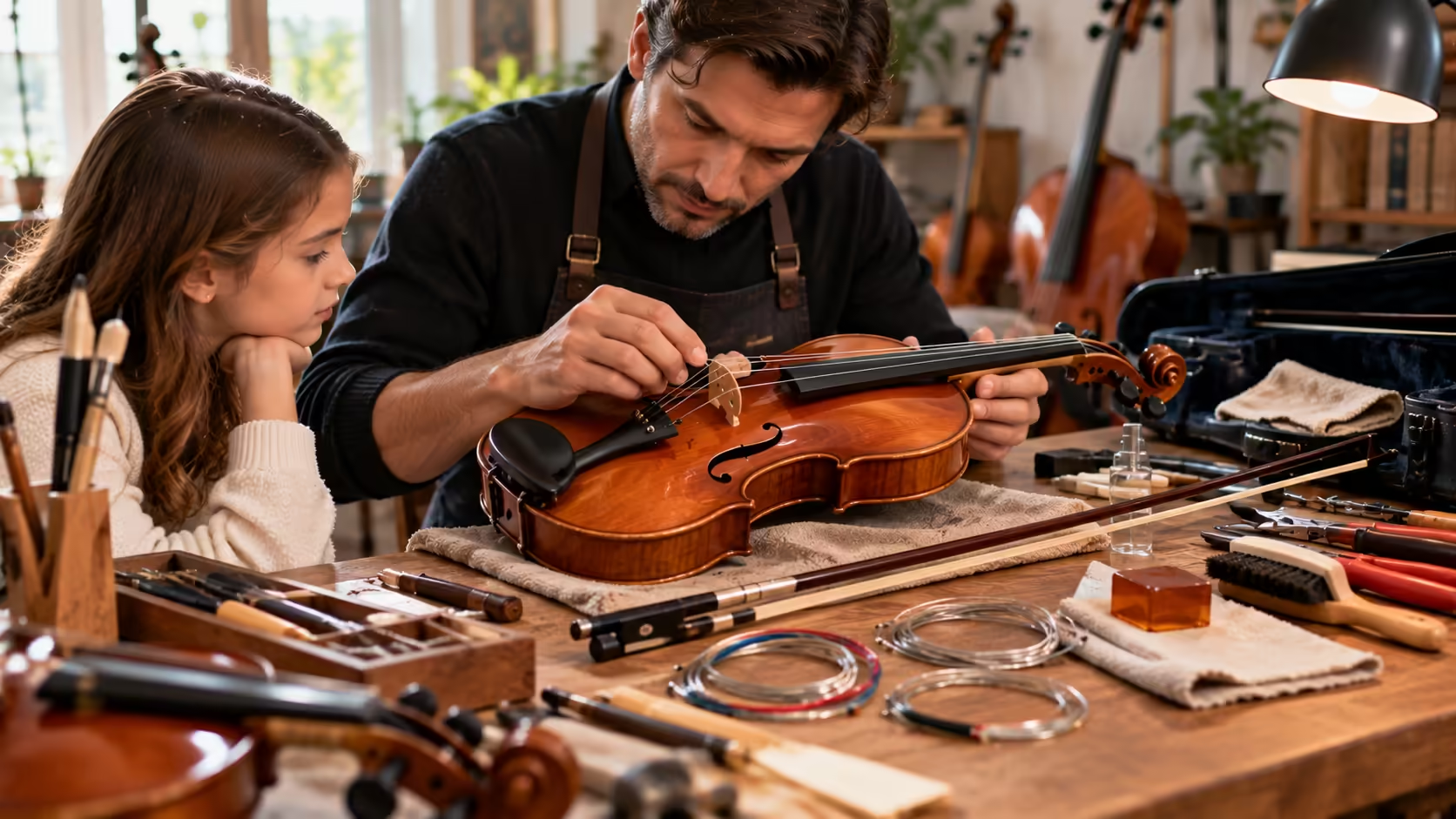
The bargain violin problem. Badly fitted pegs slip, a warped bridge raises the string height, and a beginner responds by pressing harder, tiring faster, and quitting sooner. A $60 setup at a repair shop fixes most of it — which is why a $350 instrument with a proper setup usually beats a $250 one without.
Where cutting corners is safe: cosmetics, brand prestige, and case quality. Nobody learns faster because of a logo. Used digital pianos are also a strong buy as long as the keys are weighted and the pedal works.
Where it isn’t safe: key action on a digital piano (never unweighted keys for a student taking lessons), string height on any guitar or violin, and pad condition on any woodwind. Those three decide whether the instrument helps the student or fights them. The same logic applies to bows — our guide to where to spend your money on a bow is the clearest example of a cheap part costing more later.
Is the Cost of Learning Music Worth It?
What the money buys beyond the skill: working memory, pattern recognition, sustained attention, and a daily habit of correction and repetition that carries straight into schoolwork. There’s a social return too — ensembles build friendships that routinely outlast the lessons themselves.
The honest math: ten years at about $2,700 a year is roughly $27,000, or near $52 a week. Set that against a few streaming subscriptions, a daily coffee, or one weekend trip a year. The comparison isn’t really about money. It’s about what you want your money to protect.
Three questions that predict whether the spend will work:
- Can the student practice four days a week for three months?Not perfectly, not for an hour — just four short sessions a week, consistently. This is the single best predictor of everything that follows.
- Will the instrument stay visible and reachable at home?An instrument in a closet gets played a fraction as often as one on a stand in the living room. This costs nothing to fix and it changes outcomes.
- Does the teacher fit the student’s temperament, not just their résumé?A patient teacher for an anxious beginner beats a brilliant one every time. Here’s what actually makes a great teacher.
Three yes answers mean the money will work. Two means wait a term and try a group class first.
How to Budget for Music in Five Steps
- Pick the instrument by commitment, not price. Choose the one the student will actually touch daily.
- Price the full year, not the lesson. Multiply the monthly lesson fee by 12, then add consumables, books, and fees.
- Cap the start-up. Set a number before you shop. If that number is under $400, rent instead of buying.
- Add a repair buffer. A few hundred dollars stops one bad week from ending everything.
- Review at month six. Check practice habits, teacher fit, and whether an upgrade is genuinely due.
| Expense | Monthly | Yearly |
|---|---|---|
| Private lessons (weekly, 30 min) | $170 | $2,040 |
| Supplies and consumables | $10 | $120 |
| Method books | $25 per term | $75 |
| Exams and recitals | — | $100 |
| Repair buffer | — | $300 |
| Total | — | $2,635 |
Quick Recap
The whole guide in one breath. Private lessons run $35–$50 per half hour, or about $170 a month taken weekly. A first instrument costs $150–$800 to buy, or $25–$45 a month to rent. The quiet bills — strings, reeds, books, tuning, exams, repairs — add $150–$600 a year. A realistic first year lands near $3,150 and a careful one under $500, and the three choices that move that number most are lesson length, lesson format, and whether you rent before you buy.
Conclusion: The Real Cost of Learning Music Is a Number You Control
The real cost of learning music has three parts: the lesson fee you’re quoted, the instrument you buy, and the quiet bills that follow for years. Only the first one ever makes it onto a price list — which is exactly why families get surprised.
Budget all three and the total stops being frightening. Start with a rental, a 30-minute weekly lesson, and a repair buffer, and you’re looking at roughly $52 a week for a skill that lasts decades.
Your next step: fill in that five-row budget table with real numbers from two local teachers, and ask each one about semester rates and whether materials are billed separately. Ten minutes of that beats a month of guessing.
Talk to Us Before You Spend
Our teachers will tell you honestly what a beginner needs in month one and what can wait until month twelve — and if you’d rather not buy an instrument yet, rent one from us and decide later.
FAQs About the Cost of Learning Music
How much does learning music cost for one year?
Anywhere from about $470 to $5,540, depending on the instrument and lesson format. A child taking weekly private lessons with a rented instrument typically spends around $2,800 in the first year, and slightly less after that.
How much do music lessons cost per month?
Weekly 30-minute private lessons cost about $170 a month, usually $140–$200. Weekly 60-minute lessons average about $320 a month and can reach $400 in expensive cities. Group classes often run $100–$140 a month for the same class time.
What is the cheapest instrument to learn?
Singing needs almost no equipment, so voice is the cheapest over five years. After that come the recorder ($10–$40), the ukulele ($50–$100), and the acoustic guitar ($150–$300), all with very low upkeep.
How much should a beginner spend on a first instrument?
For most instruments, $300–$800 buys something genuinely playable, and string instruments in particular should sit in that range rather than below it. Add $40–$60 for a professional setup on any string or woodwind instrument — it’s the best-value money on this page.
Is renting an instrument cheaper than buying?
For the first six to twelve months, yes. At $25–$45 a month, a year of rental costs less than one mistaken purchase, and you can change sizes as a child grows. Past about 18 months, buying usually wins on total cost.
Can you learn an instrument for free?
Partly. Free videos, library books, and school or community group classes teach the basics well. Most self-taught learners stall on tone, posture, and rhythm — the three things that need another pair of ears to fix.
Do you have to pay for music exams?
No. Graded exams are completely optional. If you choose them, beginner grades cost roughly $55–$90 depending on the board, and recorded or digital options usually cost less than in-person exams.
Which hidden costs surprise families most?
Piano tuning, reeds, bow rehairs, and exam fees. Together they add $150–$800 a year to almost any music budget, and none of them appear on a studio’s price list.
Katherine Dvoskin
Katherine is a professionally trained pianist who studied at the Gnessin School of Music in Moscow. She has spent decades teaching students of every age, and has talked more families through a first music budget than she can count — usually talking them out of half of what they thought they needed.
She writes beginner guides for K&M Music Company with one goal: make the first step small enough that anyone will take it. See all lessons at K&M Music Company →