How to Read Music Notes: The Only Beginner Guide You Actually Need
Clefs, rhythm, note values, and sheet music basics — explained in plain English, with interactive practice tools built right into the page.
The Short Version
If you want to learn how to read music notes, this guide shows you the full process in plain English — how note names work, how rhythm works, and how to read treble clef and bass clef without feeling lost.
- Start with the basics in order: note names, the staff, clefs, rhythm, measures, and a handful of symbols.
- Use memory tricks at first to learn treble and bass clef notes faster — then let them go.
- Practice a few minutes every day. Ten focused minutes beats one long session every week.
Reading music can feel strange at first. Many beginners look at a page of notes and see a puzzle. That is completely normal. The good news is that music notation follows a clear system — and once you learn a few core rules, the page starts to make sense very quickly.
This guide walks through that system one piece at a time. It also includes five interactive tools you can use right here on the page: a note-name trainer, a beat counter, a measure builder, a practice timer, and a progress checklist. Use them as you read. Reading about music notation is useful; actually clicking through it is what makes it stick.
Quick Answer: How to Read Music Notes as a Beginner
If you want the short version of how to read music notes, do this first:
- Learn the seven note names: A, B, C, D, E, F, G.
- Learn the staff — five lines and four spaces.
- Learn the clef, because the clef tells you which notes belong on those lines and spaces.
- Learn note values, which tell you how long to hold each note.
- Learn time signatures, which tell you how beats are grouped.
- Practice one note at a time, then short patterns, then full measures.
That is the basic map. Now let’s make each part simple.
Why Learning How to Read Music Notes Matters
You do not need to read music to enjoy music. Plenty of wonderful players never learned. Still, reading music opens a lot of doors. It helps you learn songs faster, play with other people, follow lessons without getting stuck, and understand what a composer or arranger actually wanted you to do.
It also builds more than page-reading. Berklee College of Music lists pitch, rhythm, scales, intervals, chords, harmony, and melody as the core building blocks of music theory. When you learn to read music notes, you are quietly laying the foundation for every one of those skills.
And it works at any age. If you have been telling yourself you started too late, the research disagrees — adult brains are better at learning music than most people think, and note reading in particular rewards the kind of patient, systematic attention adults are good at. There is also real science behind what happens in your brain when you play music, and reading notation lights up a surprising amount of it.
What Are Music Notes?
Music notes show two main things:
- Pitch — how high or low a sound is
- Rhythm — how long or short the sound lasts
Think of written music like written language. Notes are the letters. Measures are the words. Phrases are the sentences. A single note means something small on its own. A full line of music tells a bigger idea.
That comparison matters for a practical reason. Nobody reads a book letter by letter — you recognize whole words at a glance. Fluent music reading works the same way, and the goal from day one is to move toward recognizing shapes and patterns, not decoding every dot.
The Musical Alphabet: The First Step in Reading Music Notes
The first rule of how to read music notes is very simple. Music uses only seven letter names:
A B C D E F G
Then the pattern repeats: A, B, C, D, E, F, G, A, B, C… and on it goes. Note names repeat in higher and lower ranges called octaves. That is why music has more than one C, more than one E, and more than one G.
Quick memory tip for note names
If the note you are on is C, the next note up is D. The one after that is E. Music moves in order, like the alphabet, then loops back around to A. That means if you can find one note with confidence, you can count to the notes near it.
Teacher’s note: Counting from a known note is a great beginner strategy — and a bad long-term habit. Use it while you build your landmarks, then push yourself to name notes instantly instead of counting up from C every time.
The Staff: Where Music Notes Live
The staff is the set of horizontal lines where notes are written. A standard staff has:
- 5 lines
- 4 spaces
Each line and each space stands for a different note. As notes move upward on the staff, the pitch goes up. As notes move downward, the pitch goes down. That is the first big idea in how to read sheet music for beginners: higher notes sit higher on the page.
Clefs: The Symbol That Tells You Which Notes You Are Reading
A clef is the symbol at the far left of the staff. It tells you which note names belong to the lines and spaces. Without the clef, the notes have no fixed meaning at all — the same dot on the same line means two different pitches depending on which clef is in front of it.
For beginners, there are two clefs that matter:
How to Read Music Notes in Treble Clef
Treble clef is used for higher notes. Many beginner instruments live here: piano right hand, violin, flute, and most singing parts.
Treble clef line notes, bottom to top: E – G – B – D – F
Memory phrase: Every Good Boy Does Fine
Treble clef space notes, bottom to top: F – A – C – E
Which conveniently spells: FACE
How to Read Music Notes in Bass Clef
Bass clef is used for lower notes. Piano left hand usually reads bass clef, and so do cello, bassoon, trombone, and tuba.
Bass clef line notes, bottom to top: G – B – D – F – A
Memory phrase: Good Boys Do Fine Always
Bass clef space notes, bottom to top: A – C – E – G
Memory phrase: All Cows Eat Grass
| Clef | Lines (bottom → top) | Spaces (bottom → top) | Memory phrases |
|---|---|---|---|
| Treble | E G B D F | F A C E | Every Good Boy Does Fine · FACE |
| Bass | G B D F A | A C E G | Good Boys Do Fine Always · All Cows Eat Grass |
A smart way to use mnemonics
Mnemonics are excellent at the start. Think of them as training wheels. The goal is to use them early and then move toward instant recognition, because you do not want to recite a sentence in your head every single time you see a note. If you are still spelling out “Every Good Boy Does Fine” six months from now, the mnemonic has stopped helping you and started slowing you down.
Which brings us to the fastest way to get past that stage: repetition in very small doses. Try the trainer below.
🎯 Note Name Trainer Interactive
A note appears on the staff. Name it. Switch clefs, turn on ledger lines when you’re ready, and watch your streak grow.
Which note is this?
Note Anatomy: What the Parts of a Note Mean
A written note has parts, and each part carries information:
- Note head — the oval. Its position on the staff gives you the pitch. Whether it is filled in or hollow starts telling you the length.
- Stem — the vertical line. Stems point up or down depending on where the note sits, but the direction does not change the pitch.
- Flag — the little tail. Each flag cuts the note’s length in half.
- Beam — the thick bar that connects short notes into readable groups instead of a row of separate flags.
So a hollow note head with a stem, a filled note head with a stem, and a filled note head with a flag are three different durations — same pitch, different lengths. That is the bridge into rhythm.
How to Read Music Note Values and Rhythm
Pitch tells you what to play. Rhythm tells you how long to play it. This is the second half of reading music, and honestly it is where more beginners get stuck than on note names.
| Note | Beats in 4/4 | How to count it |
|---|---|---|
| Whole note | 4 | Hold through 1 – 2 – 3 – 4 |
| Half note | 2 | Hold through 1 – 2 |
| Quarter note | 1 | One note per beat |
| Eighth note | ½ | Two per beat — “1 and 2 and” |
| Sixteenth note | ¼ | Four per beat — “1 e and a” |
Dots, ties, and beams
These three show up early, so it helps to know them before they surprise you:
- Dot — adds half of the note’s value. A dotted half note = 2 + 1 = 3 beats.
- Tie — joins two notes of the same pitch into one longer sound. You play it once and hold through both.
- Beam — links shorter notes like eighths and sixteenths into a visual group.
If that feels like a lot, don’t worry. Most beginners start with quarter notes, half notes, and whole notes, and build outward from there.
How to Read Rests in Music
A rest means silence. It tells you when not to play.
This is easy to skip past, but rests matter just as much as notes. Good rhythm depends on sound and silence equally — a whole rest = 4 beats of silence, a half rest = 2 beats, a quarter rest = 1 beat.
The most common rest mistake: treating rests like empty space to rush through. They are not empty. They are counted time. Count them out loud exactly the way you count notes, and your playing will immediately sound more controlled.
Measures, Bar Lines, and Time Signatures
Music is grouped into sections called measures (or bars). Vertical bar lines cut the staff into those groups so your eye has somewhere to rest.
At the start of a piece you will see a pair of stacked numbers — 4/4, 3/4, 6/8. That is the time signature, and it reads a bit like a fraction:
- The top number tells you how many beats are in each measure.
- The bottom number tells you what kind of note gets one beat.
The three time signatures beginners see most
- 4/4 — 4 beats per measure. Steady and by far the most common. Sometimes marked with a C for “common time.”
- 3/4 — 3 beats per measure. Feels like 1-2-3, 1-2-3. Waltz territory.
- 6/8 — six eighth-note counts, usually felt in two big rolling pulses. Think lullabies and sea shanties.
Counting out loud is the single fastest way to make a time signature real. Say “1, 2, 3, 4” steadily and clap on each number. Rhythm becomes much easier once your body feels the beat instead of your eyes just seeing it.
🥁 Time Signature Beat Counter Interactive
Hear and see the difference between 4/4, 3/4, and 6/8. The red circle is beat one — the strong beat you feel.
80Beats per minute
Try it: count out loud with the numbers, then clap only on beat one.
🧩 Measure Builder Interactive
Fill a measure with notes and rests until the beats add up exactly. This is rhythm math — and it’s the fastest way to understand what a time signature is really asking for.
0 of 4 beats filled
Ledger Lines and Middle C
Sooner or later, notes climb above or drop below the staff. When that happens, music uses ledger lines — short extra lines added outside the main staff to extend it.
Middle C is the note to learn first. It sits between the treble and bass staffs and near the middle of a piano keyboard, which makes it the anchor point everything else is measured from.
Why landmark notes beat memorizing everything
Instead of decoding every note from scratch, learn a handful of anchors and read outward from them:
- Middle C (the shared reference between both clefs)
- Treble clef bottom line E and the FACE spaces
- Treble clef G — the line the clef’s curl wraps around
- Bass clef F — the line between the clef’s two dots
- Bass clef top line A
Once those five or six are automatic, every nearby note is one or two steps away. This is exactly how experienced readers actually read — not by naming every note, but by recognizing where they are and moving by distance. If you play keys, our guide on how to read piano sheet music goes deeper on landmark reading across two staves at once.
Sharps, Flats, and Naturals
Now a new layer. Some notes get changed by symbols called accidentals:
- Sharp (♯) — raises the note by a half step
- Flat (♭) — lowers the note by a half step
- Natural (♮) — cancels a sharp or flat
An accidental is written before the note it affects, and it applies for the rest of that measure unless something cancels it.
A beginner-friendly way to think about it: if regular note names are street names, accidentals are tiny address corrections. The letter stays the same — the pitch just shifts slightly up or down.
Key Signatures: Why Some Notes Keep Coming Back as Sharp or Flat
A key signature is the group of sharps or flats placed right after the clef at the start of each staff. It tells you which notes stay changed for the entire piece, so the writer doesn’t have to mark them over and over.
Berklee lists scales and key signatures as part of the core early theory path, and you will meet them in real music almost immediately. That does not mean you need to master all fifteen on day one. Here’s what actually matters at the beginning:
- A key signature saves space and keeps the page readable.
- It shows the home key of the music.
- It tells you to expect certain sharps or flats again and again.
- A natural sign later in the piece temporarily cancels one of them.
Dynamics and Articulation: The Clues That Shape the Sound
If notes tell you what to play and rhythm tells you when, dynamics and articulation tell you how.
| Symbol | Name | Meaning |
|---|---|---|
| p | piano | Soft |
| mp | mezzo-piano | Medium soft |
| mf | mezzo-forte | Medium loud |
| f | forte | Loud |
And the common articulation marks:
- Staccato (a dot above or below the note) — short and light
- Accent (a small arrow shape) — emphasize the note
- Slur (a curved line over several different pitches) — connect them smoothly
These are the marks that turn correct notes into actual music. Two players can read identical pitches and rhythms, and dynamics and articulation are most of what makes one performance sound alive and the other sound like a typing exercise.
How to Read Music Notes Step by Step
Here is the practical system. When you sit down with a new piece, run these six checks in order.
Step 1: Check the clef
Before you name a single note, look at the clef. The same line means one thing in treble clef and something completely different in bass clef.
Step 2: Look at the time signature
See how many beats belong in each measure. This tells you how to count before you play anything.
Step 3: Name the note
Is it on a line or in a space? Use your mnemonic if you need it, or count from the nearest landmark.
Step 4: Check the note value
Whole, half, quarter, or something smaller? Filled head, hollow head, flag, dot — each one changes the length.
Step 5: Watch for accidentals
Look just before the note, and check the key signature at the start of the line.
Step 6: Count while you play or clap
Out loud. Reading gets dramatically easier when your eyes, hands, and voice are all doing the same job at the same time.
A real beginner example
Imagine you see a note in treble clef sitting on the bottom line. That line is E. The note head is filled in and has a stem, so it is a quarter note — one beat. The time signature is 4/4, so it takes up one of the four beats in that measure.
That is the whole process. Note reading is just a stack of small clues: clef → location → note value → measure count → any sharp or flat. One clue at a time is enough.
Common Problems Beginners Face When Reading Sheet Music
Most beginners do not struggle because they are “bad at music.” They struggle because they try to read too much, too fast. Here are the six problems I see most often as a teacher, and what to do instead.
Problem 1: Treating every note like it’s brand new
Fix: Learn five landmark notes cold, then read by distance from them.
Problem 2: Ignoring rhythm and focusing only on pitch
Fix: Clap the rhythm all the way through before you play a single note.
Problem 3: Leaning on mnemonics forever
Fix: Set a deadline. Use them for a few weeks, then force instant recognition with short timed drills like the trainer above.
Problem 4: Never counting out loud
Fix: Count aloud even when it feels silly. Silent counting is where rhythm quietly falls apart.
Problem 5: Skipping rests
Fix: Count rests exactly like notes. Silence is written down for a reason.
Problem 6: Practicing too long in one sitting
Fix: Short and daily beats long and occasional, every time. Even five focused minutes a day builds real reading skill — this is the same principle behind the 10-minute practice rule.
One more thing worth saying: progress in note reading is genuinely hard to feel from the inside. If it seems like nothing is improving, read how to tell you’re making progress even when it feels slow before you conclude you’re stuck. Usually you aren’t.
Best Practice Routine for Learning How to Read Music Notes
You do not need a huge practice block. You need a small routine you will actually repeat. Here is the ten-minute plan I give beginning students:
| Minutes | What you do | What it trains |
|---|---|---|
| 1–2 | Review treble or bass clef notes | Recall |
| 3–4 | Name notes with flashcards or the trainer above | Speed |
| 5–6 | Clap simple rhythms out loud | Timing |
| 7–8 | Read one measure at a time, slowly | Application |
| 9–10 | Play or sing what you just read | Connection |
This works because it stays short and specific. You train recognition, rhythm, and real use inside one small block — and because it’s only ten minutes, you’ll actually come back tomorrow.

⏱ 10-Minute Practice Timer Interactive
Runs the full routine above, two minutes per step, and tells you when to move on. Start it right now and do your first session while the page is open.
10:00
Press start when you’re ready
How to Read Music Notes on Piano, Guitar, and Voice
The basics stay the same across every instrument. How you use them changes a bit.
Piano
Piano beginners read treble and bass clef at the same time, which makes the first weeks feel harder — and then makes you a noticeably stronger reader than everyone else six months later. Middle C and the keyboard itself give you a physical reference that other instruments don’t have. If you’re starting from zero, our piano lessons build note reading in from the first session rather than bolting it on later.
Guitar
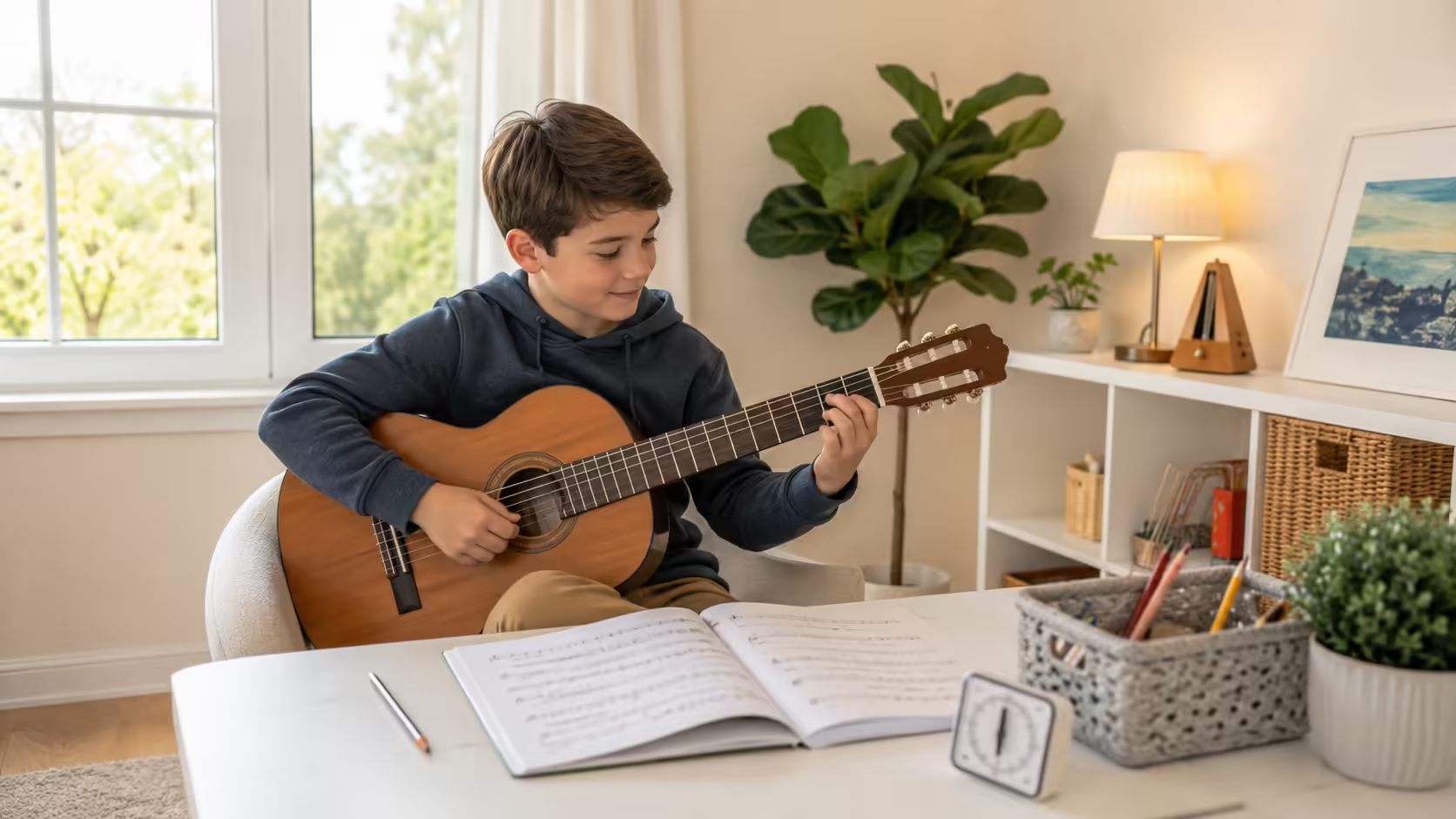
Guitarists usually start with chord diagrams and tablature, then come to staff notation later. Reading notes still matters, though — it sharpens rhythm, pitch awareness, and your grip on theory, and it’s what lets you play with musicians who don’t use tab. Pair this guide with music theory for guitar, and see our guitar lessons if you’d rather not piece it together alone.
Voice
Singers get a lot from reading, because it directly improves pitch matching, sight-singing, and choir work. If you sing in a group, even basic note-reading turns rehearsals from stressful guessing into following along.
Still deciding what to play? The easiest instruments to learn as an adult is a good place to start, and piano vs. guitar settles the most common tie-break.
Mini Glossary of Music Reading Terms
| Term | What it means |
|---|---|
| Staff | Five lines and four spaces where notes are written |
| Clef | Symbol that tells you which note names sit where |
| Pitch | How high or low a note sounds |
| Rhythm | How long each note lasts |
| Measure | A group of beats |
| Bar line | The vertical line separating measures |
| Ledger line | Short extra line above or below the staff |
| Accidental | A sharp, flat, or natural |
| Key signature | Sharps or flats set at the start of the staff |
| Time signature | Numbers showing how beats are grouped |
| Dynamics | Loud and soft markings |
| Articulation | How notes are shaped or connected |
✅ Beginner Music Reading Checklist Saves your progress
The full skill list, in the order I’d teach it. Tick items off as you get them — this page remembers where you left off on this device.
0 of 12 complete
Learn It Faster With Someone Watching
Self-study gets you a long way with note reading — but a teacher catches the small habits that quietly slow you down, and adjusts the pace to you. K&M Music Company offers private lessons for all ages and instruments, instrument rentals for students, and scheduling that works around your week.
Not sure what a first lesson is even like? Here’s exactly what to expect at your first music lesson.
Frequently Asked Questions About How to Read Music Notes
Is reading music notes hard for beginners?
It can feel hard for the first few days, mostly because everything is unfamiliar at once. After that it gets much easier, because the same small set of patterns repeats endlessly. There are only seven note names, one staff shape, and a handful of rhythm values — once those click, most new music is a recombination of things you already know.
How long does it take to learn how to read sheet music?
You can learn the basics in a few days and feel reasonably comfortable within a few weeks of short daily practice. Real fluency — reading at speed without decoding — takes months. Steady practice matters far more than talent here, and ten minutes a day will beat two hours every other Sunday.
Do I need to memorize every note at once?
No, and trying to is the most common way beginners burn out. Start with five or six landmark notes — middle C, treble E and G, bass F and A — and read everything else by its distance from those. The rest fills in on its own with use.
Should I learn treble clef or bass clef first?
If you play a higher-range instrument or sing, start with treble clef. If you play a lower-range instrument like cello, bassoon, or tuba, start with bass. Piano students end up learning both — usually treble first, with bass introduced within the first few weeks.
What is the easiest way to remember notes on the staff?
Mnemonics first, then direct recognition. FACE for the treble spaces and Every Good Boy Does Fine for the treble lines are still popular because they genuinely work for beginners. Just treat them as temporary — after a few weeks, drill for instant recognition instead of reciting the phrase each time.
Can I learn to read music without an instrument?
Yes, partly. You can learn note names, rhythm values, time signatures, and symbols with nothing but a page — clapping rhythms and naming notes out loud gets you surprisingly far. But connecting written notes to actual sound is where reading becomes useful, so pair it with an instrument or your own voice as soon as you can.
Why do rests matter as much as notes?
Because rhythm is made of sound and silence in equal measure. A rest is not empty space to hurry through — it is counted time with a specific length. Beginners who count rests properly sound controlled and deliberate; beginners who skip them sound rushed, even when every pitch is correct.
What should I learn after basic note reading?
Move on to key signatures, scales, intervals, chords, sight-reading, and ear training — roughly in that order. That path lines up with the core theory sequence Berklee outlines, and each step makes the reading you already do faster and more meaningful.
Conclusion: How to Read Music Notes With Confidence
Learning to read music gets much easier once you stop seeing it as one giant skill. It is really a group of small ones. You learn the musical alphabet. Then the staff. Then clefs, rhythm, measures, and a few symbols at a time.
If you remember one thing from this guide, remember this: read slowly, count clearly, practice daily. That is the whole path. The notes on the page will stop looking random, then start looking familiar, then readable — and eventually you’ll stop noticing you’re reading at all, because you’ll just be playing music.
Bookmark this page and come back to the trainer and the practice timer as often as you like. A short review each day makes a bigger difference than anything else you could do.
Katherine Dvoskin
Katherine is a professionally trained pianist who studied at the Gnessin School of Music in Moscow. She has spent decades teaching students of every age — from four-year-olds meeting middle C for the first time to adults who assumed the window had closed on them.
She writes beginner guides for K&M Music Company with one goal: explain music clearly enough that nobody has to feel lost on page one. See all lessons at K&M Music Company →